
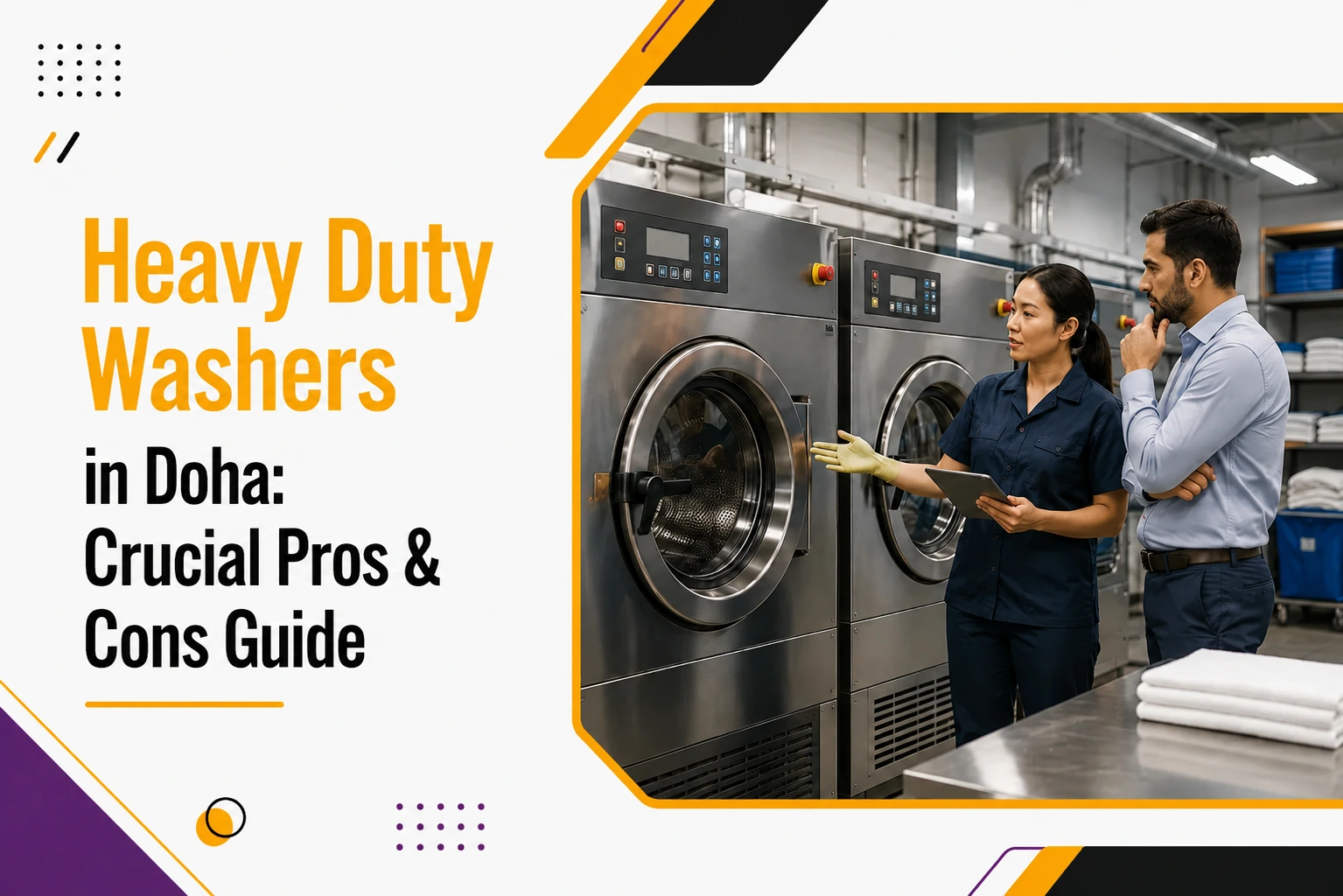
Doing laundry at home is not the same as managing a hotel, a labor camp, or a facility that processes hundreds of loads of laundry each day. A single malfunctioning machine on a Sunday morning can result in the delivery of uniforms, the failure to change bed linens, and the collapse of a complete operations schedule by midday.
For this reason, a lot of facility managers in Qatar are currently debating whether heavy-duty washers are worth the investment or if a smaller arrangement with more units is a better option.
There is not just one correct response. Your building’s power and water infrastructure, load volume, and the downtime your business can tolerate before issues arise are all important factors. This guide walks through crucial pros and cons of heavy-duty washers in Doha, so you can make the call with real information instead of a sales pitch.
Why Commercial Laundry Decisions Matter More in 2026
Qatar’s labor accommodation sector and hospitality industry have both grown fast, and laundry infrastructure has quietly become one of the most overlooked operational bottlenecks in both. A labor camp housing a few thousand workers is not comparable to a household doing two loads a week. Neither is a mid-sized hotel that processes staff uniforms, towels, and bed linens continuously.
Facility managers are under simultaneous pressure from multiple sources. Health authorities continue to tighten cleanliness standards for shared housing, occupancy rates continue to rise, and energy and water prices continue to rise. A laundry arrangement that was successful two or three years ago is frequently the same system that is currently having difficulty keeping up.
This is the backdrop against which the decision to invest in commercial washing machines gets made, and it is why getting the pros and cons right matters more than ever this year.
What Counts as a Heavy-Duty Washer
Not every large-looking machine qualifies as heavy duty. In a genuine commercial or industrial setting, heavy-duty washers typically share a few defining traits:
- Drum capacity ranging from 15kg on the smaller commercial end up to 100kg or more for large-scale industrial units
- Reinforced stainless steel drums built to withstand continuous cycles without warping
- Higher spin speeds that reduce drying time and energy load downstream
- Programmable wash cycles for different fabric types, from bedsheets to workwear
- Heavy-duty motors rated for extended daily runtime, not occasional home use
If a facility is running loads back-to-back for ten or more hours a day, that machine needs to be built for industrial duty, not adapted from a residential design.
This distinction is the entire reason suppliers of industrial laundry machines in Qatar stock them priced and engineered so differently from ordinary appliances.
The Pros of Heavy-Duty Washers in Doha
1. Massive Capacity Cuts Turnaround Time
Volume is the main benefit of heavy-duty washers. A facility that previously required six regular machines to run continuously may frequently swap them out with two or three high-capacity units and finish the same load of laundry in a fraction of the time.
That difference is not insignificant for a labor camp with hundreds of residents. It implies:
- Quicker turnaround for bedding and uniforms
- Fewer bottlenecks during peak laundry hours
- Less staff time spent loading, unloading, and monitoring machines
- More predictable daily scheduling for laundry teams
2. Built to Handle Qatar’s Heat and Hard Water
Doha’s climate and water conditions are tough on equipment that was not designed for them. Heavy-duty washers are engineered with components rated for continuous operation in high ambient temperatures, and better units come with descaling-friendly systems that cope with the region’s naturally hard water.
Standard residential-grade machines simply were not built for this environment. They tend to fail faster, develop mineral buildup sooner, and struggle with the sustained runtime that labor camps and hotel laundry rooms demand.
3. Lower Cost Per Load Over Time
The upfront price of a heavy-duty washer looks high compared to a domestic-style machine, but the cost per load is lower when you consider the volume.
Bulk capacity machines typically deliver the following:
- Lower water usage per kilogram of laundry compared to running multiple smaller machines
- Decreased heavy-duty electricity costs
- Fewer replacement cycles thanks to industrial-grade components
- Lower detergent waste through calibrated dosing systems
Facility managers consistently find that commercial washing machines pay for themselves faster than expected over a 5 to 10-year period, especially when factoring in the total cost of saved labor hours.
4. Consistent Hygiene Standards for Labor Camps and Hotels
In shared accommodations and hospitality situations, compliance with health and hygiene regulations is mandatory. When it comes to eliminating the presence of bacteria from shared bedding, towels, and uniforms, heavy-duty washers often have longer, more controlled cycles and higher wash temperatures than regular household machines.
For a facility housing large numbers of residents, dependable labor camp washing machines Doha operators trust are not a comfort upgrade. They are close to a compliance requirement, and getting this wrong carries real reputational and regulatory risk.
The Cons You Need to Weigh Before Buying
1. High Upfront Investment
This expense is one that cannot be avoided. A whole outfit for a large labor camp or hotel laundry facility frequently requires a significant capital commitment before a single load has been washed, and genuine heavy-duty washers are far more expensive than typical commercial units.
Rather than assuming that a single lump-sum purchase is the only option, facility managers should consider financing options, phased rollouts, or leasing agreements.
2. Space, Power, and Water Infrastructure Demands
Heavy-duty machines are physically large and draw considerably more power and water per cycle than domestic units. Before purchasing, facilities need to confirm:
- Floor space and structural load capacity for the machine footprint
- An electrical supply that can manage the loads of industrial motors
- Infrastructure for drainage and water pressure that is sized for high-volume cycles
- Ventilation to manage heat and humidity generated during continuous runs
Retrofitting an existing laundry room not designed for industrial equipment may lead to unexpected costs, in addition to the cost of the machine itself.
3. Risk of Maintenance and Downtime
A machine requires more regular maintenance the longer it operates. A breakdown on a high-capacity unit affects significantly more laundry volume than a single small machine failure, and heavy-duty washers used continuously in a labor camp or hotel setting may require planned maintenance.
Facilities without a reliable maintenance contract or a responsive local supplier often discover this truth the hard way, usually during the worst possible week for it to happen.
Labor Camp Laundry vs Hotel Laundry: Different Needs, Same Machine Category
Not every heavy-duty washer setup should look the same. When it comes to large quantities of similar products like uniforms and bedsheets, a labor camp usually prioritizes sheer volume and cost effectiveness. On the other hand, to safeguard more expensive linens, towels, and visitor laundry, a hotel requires a combination of capacity and gentler cycle options.
Hotel laundry equipment in Doha properties often includes additional finishing equipment, such as ironers and folding stations, that a labor-camp setup would not typically need.
Matching the machine specification to the actual use case, rather than buying the biggest available unit by default, is one of the most common mistakes facility managers make.
What to Check Before You Buy Industrial Laundry Machines in Qatar
Before signing off on a purchase order, run through this checklist:
- Confirm actual daily load volume, not an estimated average
- Verify electrical and water infrastructure can support the machine specification
- Request written documentation of the load capacity, spin speed, and cycle time.
- Before committing, review the conditions of the warranty and the availability of local parts.
- Verify if the seller provides installation assistance in addition to shipping.
- Compare the entire cost of ownership, not just the sticker price, over a period of five to ten years.
- If you run many facilities, find out if the supplier can service them all.
Working with a trusted bulk appliance supplier in Qatar removes most of the guesswork from this process since a proper supplier will walk through these questions before a quote is even issued.
Why Facility Managers Choose Adonai Solutions
Adonai Solutions has built its reputation in Doha on getting the fundamentals right the first time, whether that is trading and bulk equipment supply, facility maintenance, or full-scale procurement support for large accommodation projects.
When it comes to outfitting a labor camp or hotel laundry facility, Adonai Solutions helps facility managers work through the exact questions this guide raises:
- Is the machine specification actually matched to daily load volume?
- Does the proposed equipment fit with the site’s current infrastructure?
- What does the unit’s total cost of ownership look like over its entire life?
- Is continuing maintenance assistance actually offered, or is it only a promise made at the time of purchase?
Supported by the same one-stop strategy used by its trading, cleaning, and facility services businesses, Adonai Solutions provides commercial washing machines and related bulk equipment throughout Doha. For operations that would rather manage one trusted supplier than chase multiple vendors, that consistency carries real value.
Conclusion
Heavy-duty washers are not a purchase you make on instinct. They require significant upfront funding, appropriate water and power infrastructure, and a maintenance strategy that can withstand ongoing daily use. However, the benefits, which are faster turnaround, cheaper cost per load, and hygienic standards that a domestic-style machine just cannot match, are equally significant for a labor camp or hotel processing hundreds of loads every week.
Facilities that make this decision correctly consider it an infrastructure investment rather than a one-time appliance purchase, balancing the seven pros and cons discussed above with their real daily volume, site characteristics, and long-term budget. Making a quick selection or going with the largest machine on the shelf usually ends up costing more in the long term than taking the time to properly size it the first time.
The quickest approach to arrive at the correct specification without going over or under budget is to work through the checklist in this guide with a supplier like Adonai Solutions who is familiar with both labor camp and hotel operations in Doha.
Ready to Outfit Your Laundry Facility?
Whether you are planning a laundry room for a labor camp from scratch or upgrading an existing hotel facility, getting the equipment specification right the first time saves years of operational headaches.
Frequently Asked Questions
What is the typical lifespan of a heavy-duty washer used in a labor camp setting?
Even with constant daily use, a real industrial-grade washer can function reliably for ten to fifteen years with the right maintenance. Water quality, the frequency of servicing, and whether the machine was initially sized appropriately for the actual load volume all have a significant impact on lifespan. The quickest method to drastically reduce that lifespan is to cut maintenance costs.
What is the actual number of heavy-duty washers required for a mid-size labor camp?
One high-capacity machine per 150 to 200 residents for a typical daily wash cycle is a reasonable starting point, but the answer depends entirely on resident population and turnaround expectations. Underestimating capacity is a frequent and expensive error. To avoid such errors, facility managers should work through actual load volume calculations with a supplier rather than speculating.
Are heavy-duty washers more expensive to run than several smaller commercial machines?
In general, no. A smaller number of high-capacity machines often consume less water and electricity per kilogram of laundry than numerous smaller units operating in parallel once volume reaches a certain level. Over time, the operating cost per load typically decreases despite the greater initial cost.
What distinguishes real industrial units from commercial washing machines?
Commercial machines, which are usually found in smaller hotels or laundromats, are designed for modest continuous use. With reinforced components rated for far longer daily endurance, industrial machines are designed for sustained, high-volume, nearly continuous operation. Labor camps and large hotels almost always need the industrial category rather than standard commercial-grade equipment.
Can heavy-duty washers be installed in existing laundry rooms, or does new construction need to be done?
In many situations, retrofitting is feasible, but it depends on the water infrastructure, electricity supply, and floor load capacity that are currently in place. Before making a purchase, a thorough site survey will determine whether any upgrades are required. One of the most frequent reasons for installation delays and unexpected costs is skipping this step.
Does Adonai Solutions only supply equipment, or does it also manage installation?
Adonai Solutions supports facility managers through the full process, from specifying the right equipment for actual load volume through to delivery and installation coordination. This is part of the same integrated approach the company uses across its trading and facility service divisions in Doha.