
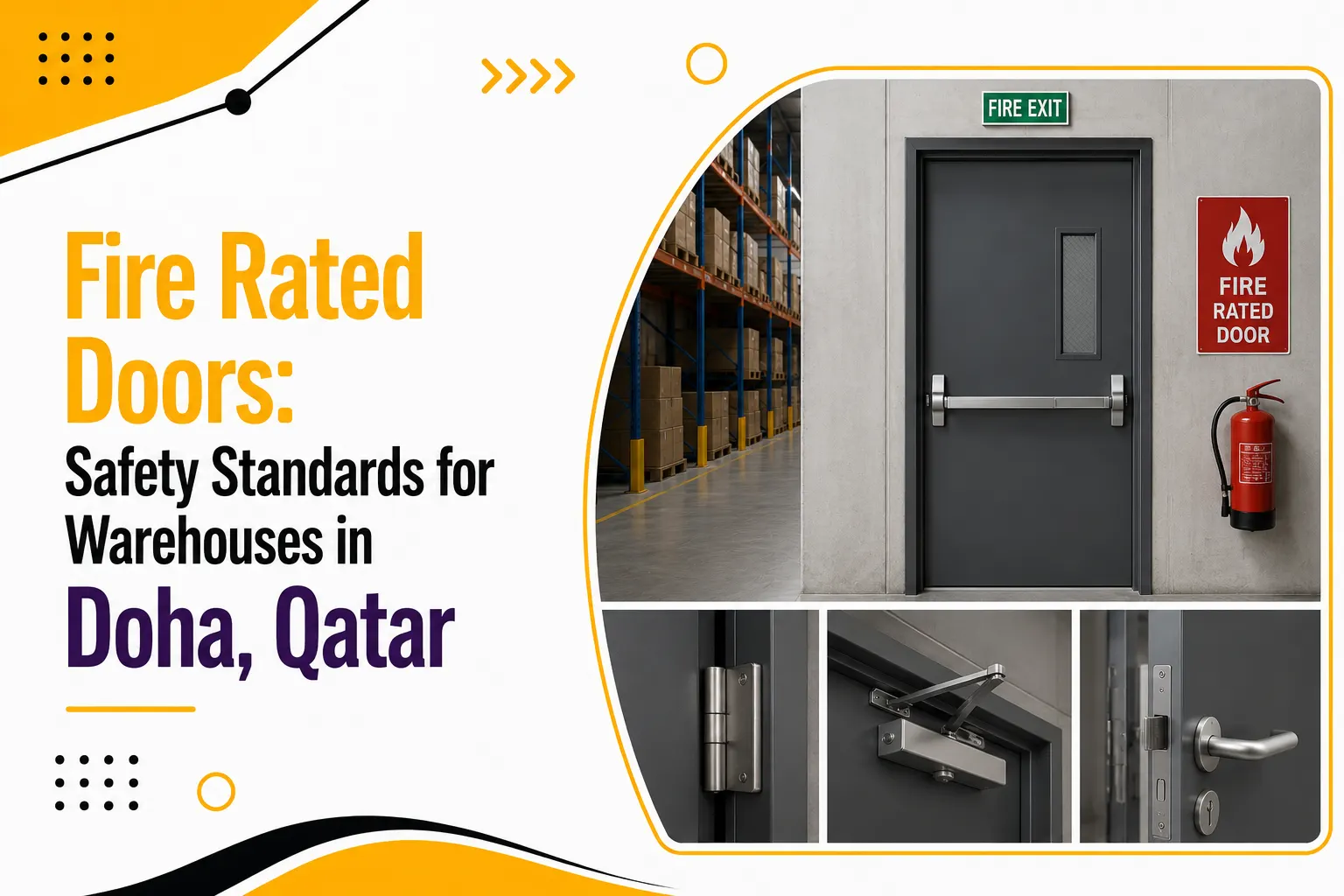
A warehouse fire does not wait for readiness. It processes racking and stored inventory faster than most facility teams expect, and a door can be the deciding factor between a confined incident and a complete loss. Until they are the only thing separating a little fire from a major disaster, fire-rated doors are one of the most neglected aspects of warehouse security in Doha.
Facility managers are reconsidering the definition of “secure” in Qatar’s industrial zones. For many years, facility managers limited the topic of warehouse security to locks and cameras. What prevents a fire from spreading is the new issue that insurers and Qatar Civil Defense inspectors are raising. The doors are becoming the first place to look for the solution.
This guide explains what fire-rated doors are, the safety door requirements for buildings in Qatar, and how to select steel fire-rated doors that are actually durable. We will also examine the legal standards for fire-rated doors, how they differ from other business entryways, and what needs to be verified before approving any provider.
The Significance of Fire-Rated Doors for Doha Warehouse Security
Qatar’s warehousing sector has grown rapidly. Construction logistics yards, pharmacies, food distribution centers, and e-commerce fulfillment centers have all expanded since 2022, attracting more attention from regulators and insurers.
Fire-rated doors sit at the intersection of two previously independent goals, which is warehouse security and fire safety. Here is why fire-rated doors matter right now:
- Qatar Civil Defence inspections are becoming more detailed, and compartmentation failures are a common reason facilities get flagged
- Insurers are reviewing passive fire protection, not just sprinklers and alarms, more frequently.
- Nowadays, warehouse security involves more than just who may enter, but it also involves how well a structure prevents damage in the case that something goes wrong.
- Timber or thin sheet-metal doors that were never intended for fire compartmentation are frequently still present in older buildings that have been renovated for new occupants.
A single non-compliant door in the wrong location can ruin an otherwise carefully planned fire plan. For these reasons, fire-rated doors should receive the same level of importance as electrical systems, racking, and access control.
How Do Fire-Rated Doors Work?
There is more to a fire-rated door than merely a heavier or thicker standard door. The door leaf, frame, hinges, seals, and hardware are all evaluated collectively under laboratory fire conditions and given a time rating, typically 30, 60, 90, or 120 minutes, because it is a tested assembly.
This grade indicates how long a fire-rated door can withstand fire penetration and limit heat transmission before collapsing, giving critical time for escape and emergency intervention.
Fire-rated doors work through a combination of physical properties:
- Insulating core materials that reduce the door leaf’s ability to transfer heat
- Intumescent seals fitted around the frame that, when heated, expand to seal openings that would otherwise let flames and smoke flow through.
- Self-closing mechanisms that ensure the door closes automatically, as an open fire-rated door provides no protection at all
- Certified hardware, including hinges, locks, and vision panels, that are tested as part of the same assembly and not added afterward
Core Components of a Certified Steel Fire Door
The following certified components are typically found in steel fire-rated doors used in Qatari warehouses:
- A leaf made of strengthened or galvanized steel with an insulating core that resists fire
- Matching steel frame, since pairing a certified door with an uncertified frame voids the rating
- Smoke seals and intumescent strips placed in accordance with manufacturer specifications
- When vision panels are necessary, fire-rated glazing
- Locking hardware, hinges, and approved closers rated for the same duration as the door
Every component needs to work together with the others. An unapproved lock or nonrated hinge can be used to secretly eliminate a fire-rated door of its functionality, even if it looks correct from the outside.
Safety Door Standards Every Facility Manager Should Know
Understanding safety door standards is where most procurement decisions go right or badly wrong. The difference between a door that “looks industrial” and one that has passed official fire resistance testing is only apparent in the case of a real incident or a thorough assessment.
Benchmarks for International Certification
Facility managers sourcing fire-rated doors in Qatar should look for compliance with recognized frameworks:
- EN 1634-1: the European standard for fire resistance testing of door and shutter assemblies
- BS 476: British standard covering fire tests on building materials and structures, still widely referenced across Gulf projects
- UL 10C: the American standard for positive-pressure fire tests of door assemblies
- NFPA 80: covers installation and ongoing maintenance requirements for fire doors and windows
Compared to a supplier who merely claims that its fire-rated doors are “fire resistant” without supporting paperwork, a supplier who can generate test certificates referencing these standards is providing something very different. Consider it a caution indication if a certificate cannot be produced upon request.
Requirements for Civil Defense in Qatar
Compartmentation, escape routes, and passive fire protection are all mandated by Qatar Civil Defense, which is in charge of commercial and industrial structures in the country. Warehouses must show that high-risk storage areas, evacuation routes, and compartment boundaries have fire-rated doors installed.
When preparing for a NOC renewal or Civil Defense inspection, facility managers should be ready to demonstrate the following:
- Fire rating certificates for every door assembly in a fire-rated location
- Evidence that installation followed manufacturer specifications
- Maintenance records confirming self-closing mechanisms and seals remain functional
- Fire doors must always be kept closed or self-closing, according to signage
During a routine inspection, inspectors are most likely to identify facilities that view these as one-time tasks rather than continuing responsibilities.
Fire-Rated Doors vs Standard Commercial Entryways
Although they may appear similar from a distance, fire-rated doors and standard business entryways are not interchangeable.
Feature | Standard Commercial Entryways | Fire Rated Doors |
Fire resistance | Little to none | Tested and certified (30–120 minutes) |
Core material | Often hollow or lightweight | Insulated steel or composite core |
Seals | Standard weatherstripping | Intumescent seals that expand under heat |
Closing mechanism | Optional | Mandatory self-closing hardware |
Hardware certification | Not required | Hinges, locks, and closers tested as part of the assembly |
Regulatory requirement | General building code | Qatar Civil Defence fire compartmentation rules |
The sole purpose of fire-rated doors is to hold fire long enough to keep people safe and minimize damage. When a fire-rated entrance is legally necessary, using a regular doorway is a noncompliance that will not go unnoticed for long.
Important Characteristics of Fire-Rated Doors
Look past the sales pitch and concentrate on verifiable standards when assessing fire-rated door vendors. Before placing any orders, make sure of the following:
- An official fire rating (30, 60, 90, or 120 minutes) defined according to the particular compartment’s specifications rather than merely a general “fire resistant” label
- Third-party test certificates that mention EN, BS, or UL standards
- Certified steel construction with a properly rated insulating core, not just a heavy-gauge shell
- Intumescent seals fitted correctly around the full perimeter of the frame
- Self-closing hardware rated for the same duration as the door itself
- Fire-rated vision panels, if visibility through the door is operationally necessary
- Manufacturer installation guidelines that your contractor is willing to follow exactly, with no field modifications
- A clear maintenance schedule provided at handover, not left for the facility team to figure out later
A fire-rated door that ticks every box here is a genuine safety asset. Missing even a couple of these elements may look the part while offering a fraction of the protection.
Where Fire-Rated Doors Are Required Inside a Warehouse
Not every door inside a warehouse needs to be fire rated, but the locations that do are non-negotiable from a compliance standpoint. Fire-rated doors are typically required at:
- Doors separating high-risk storage areas from office or staff zones
- Doors along designated escape routes and stairwells
- Doors between adjoining warehouse compartments, particularly where different tenants or storage classes share a building
- Entrances to server rooms, electrical rooms, and plant rooms
- Loading bay access points that connect directly to storage compartments
- Doors protecting storage areas for chemicals, medications, or combustible materials
Instead of making assumptions, ask for a formal compartmentation assessment if you are not sure if an opening needs a fire-rated door. Getting this wrong either way creates avoidable cost or avoidable risk.
Installation and Maintenance Best Practices
A certified fire-rated door installed incorrectly performs no better than an uncertified one. Installation quality is where most compliance failures originate, not the manufacturing itself.
Best practices for installation and ongoing maintenance include:
- Using installers trained specifically on fire door assemblies, not general contracting crews
- Confirming the frame, hinges, and hardware are all rated to match the door leaf
- Verifying gap tolerances meet manufacturer specification, since oversized gaps compromise the seal
- Never trimming, drilling, or modifying a certified door without manufacturer approval
- Formal inspections should be scheduled at least once a year, and staff members should regularly visually inspect doors for gaps that exceed tolerance, non-certified replacement hardware, fading or missing fire door signage, damaged seals, and doors that no longer self-close and latch.
Facilities that incorporate these checks into a regular calendar perform better during Civil Defense inspections compared to those that treat fire-rated doors as a set-and-forget installation.
Why Locks Are Not Enough for Warehouse Security
Warehouse security, including cameras, locks, badges, and perimeter fencing, is often treated as access control. All of that matters, but it addresses only one category of risk. Fire-rated doors extend warehouse security to include what happens during an active incident, not just who is allowed through a door on a normal working day.
A facility with excellent access control but non-compliant fire-rated doors is still exposed in a way access control cannot fix. Genuine warehouse security means treating the building as a complete system, which is why fire-rated doors increasingly come up alongside CCTV and perimeter security, rather than being filed separately under “building compliance.”
Why Facility Managers in Doha Choose Adonai Solutions
Specifying fire-rated doors correctly the first time is far cheaper than discovering a compliance gap during a civil defense inspection or an actual fire. Adonai Solutions works with facility managers across Doha to source and install certified steel fire-rated doors meeting recognized safety door standards, backed by documentation rather than vague assurances. Before recommending any fire-rated door, we ask the following:
- Is this door certified to a recognized international standard?
- Does the frame and hardware match the same fire rating as the door leaf?
- Will installation follow manufacturer specifications exactly?
- Is a maintenance plan provided at handover, not left as an afterthought?
Warehouses that get this right are not the ones that chose the cheapest door on the quote sheet. They are the ones that treated fire-rated doors as core infrastructure, backed by certification and professional installation from a supplier who stands behind the paperwork.
Conclusion
Fire-rated doors are no longer a niche compliance detail buried in a building code appendix. For warehouses across Doha, they represent one of the most cost-effective investments in life safety and property protection. Facilities with uncertified or poorly maintained doors face more legal, financial, and operational risks as civil defence inspections become stricter and insurers focus more on passive fire prevention.
Facility managers must understand the distinction between a typical commercial entryway and a truly tested fire-rated assembly, demand documented safety door standards, and view installation and maintenance as continuous tasks to execute the process correctly. Facility managers who do this are consistently better positioned during audits and, more importantly, better protected if the worst actually happens.
Upgrade Your Warehouse Security With Certified Fire Rated Doors
Protect your facility, your team, and your inventory with steel fire-rated doors that meet recognized international and local safety standards.
Frequently Asked Questions
What is the standard fire rating required for doors in Doha warehouses?
The most typical specifications for warehouse storage sections, escape routes, and compartment boundaries in Qatar are 60-minute and 90-minute rated doors, while the exact rating depends on the building’s compartmentation scheme. 120-minute rated assemblies are frequently needed in high-risk areas like chemical storage or pharmaceutical stockrooms. The correct rating for any opening should be confirmed through a formal compartmentation review rather than assumed, since under-specifying a door in a high-risk area is a serious safety gap. Work with a supplier who can map out exactly which doors need which rating based on your building’s actual layout and stored materials, rather than applying one rating across the whole facility by default.
How can I confirm that doors with a fire rating comply with international safety door standards?
Before placing an order, ask the supplier directly for third-party test certificates, making sure the certification refers to a recognized standard like EN 1634-1, BS 476, or UL 10C. These certificates should cover the entire assembly, which includes the leaf, frame, hinges, seals, and hardware collectively, as a rating on the leaf alone does not guarantee the full assembly performs as tested. A reliable supplier will produce this paperwork without hesitation. If a provider cannot provide certification or offers vague assurances instead of documentation, consider this a serious concern. Always compare the certified rating against the specific compartmentation requirement for that location in your warehouse.
What is the difference between fire rated doors and standard commercial entryways?
Standard commercial entryways are built primarily for access control, daily durability, and weather resistance, with little to no fire resistance built in. Fire rated doors, by contrast, are tested assemblies engineered specifically to contain fire and limit heat transfer for a certified duration, typically 30 to 120 minutes, using an insulated core, intumescent seals that expand under heat, and mandatory self-closing hardware, none of which are standard on a typical entryway. Using a standard door where a fire rated assembly is legally required is a compliance failure, and the visual similarity between the two is exactly why so many facilities end up with the wrong door in a critical location without realizing it until an inspection or incident exposes the gap.
How often should fire-rated doors be inspected and maintained?
Best practice calls for a formal inspection at least once annually by a qualified inspector, in addition to regular visual checks by warehouse staff. These checks should look for damaged or missing intumescent seals, doors that fail to self-close and latch properly, visible gaps around the frame beyond tolerance, and hardware replaced with a non-certified alternative during general maintenance. Any of these issues should trigger immediate attention rather than waiting for the next scheduled review, since a fire rated door with a compromised seal or a hinge that prevents proper closing offers significantly reduced protection despite still carrying its original certification on paper. Consistent inspection and maintenance is what keeps a certified door performing the way it was tested to perform.
Can existing warehouse doors be upgraded to meet fire rated standards, or do they need full replacement?
In most cases, doors not originally manufactured and tested as fire rated assemblies cannot simply be retrofitted with add-on seals or hardware to achieve a genuine rating. Certification applies to the complete tested assembly, meaning the leaf, frame, and hardware working together exactly as evaluated in laboratory conditions, so partial upgrades typically do not meet recognized safety door standards or satisfy Qatar Civil Defence requirements. Full replacement with a certified steel fire rated door and matching frame is generally the only reliable path to compliance where a specific rating is legally required. Treat this upgrade as core infrastructure investment rather than a discretionary renovation, particularly for compartment boundaries, escape routes, and high-risk storage zones identified during a fire safety review.
Do fire rated doors also improve general warehouse security, or are they purely a fire safety measure?
While the primary function of fire rated doors is fire containment and life safety, the certified steel construction, robust frames, and heavy-duty hardware involved also contribute meaningfully to general warehouse security. A properly installed fire rated door resists forced entry better than a lightweight standard commercial entryway, simply due to the strength of materials required for certification. That said, fire rated doors should not replace a dedicated security strategy involving access control, monitoring, and perimeter protection. They are best understood as one component within a complete warehouse security plan, offering fire containment as the primary benefit with improved physical resistance as a genuine secondary advantage.