
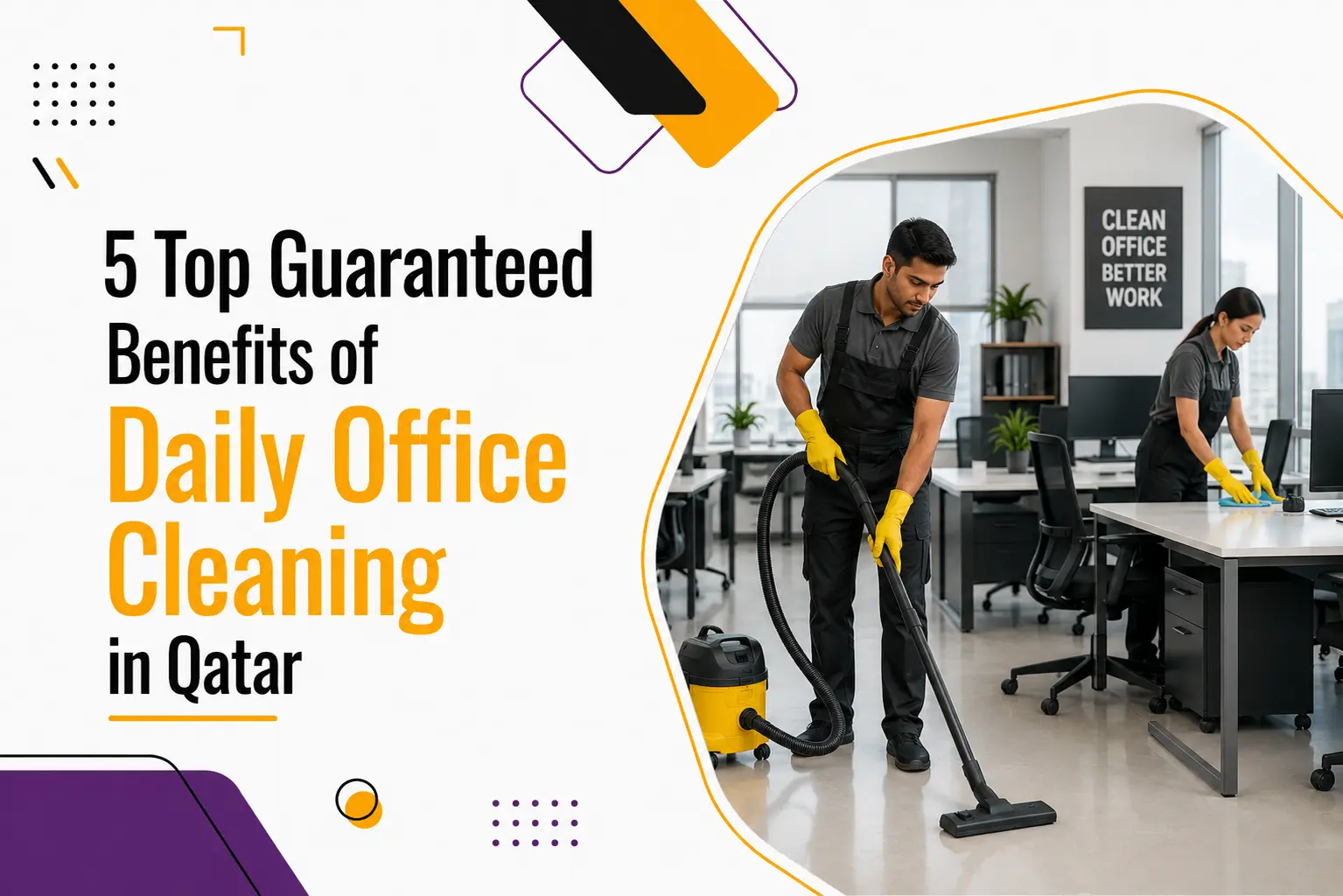
You can usually tell in a few seconds whether the cleaning crew from the previous weekend actually showed up if you walk into any office on a Monday morning. Coffee rings on the communal table, dust on the monitor stands, and an obviously unemptied bin on Friday. It seems insignificant until you see how it alters the room’s atmosphere. Visitors make an impression before anyone speaks, employees take a little longer to settle into their desks, and the entire area does not seem like a place where people want to be productive.
For businesses that take their workplace seriously, office cleaning in Qatar has changed from an occasional chore to a daily operational responsibility. In this guide, we will go over five definite advantages of moving to daily professional cleaning, what a true B2B janitorial service entails, and how it relates to more general workplace hygiene Doha standards that customers and staff are beginning to demand.
The justification for daily cleaning is stronger than most business owners know, regardless of whether you oversee a multi-story corporate headquarters or a small startup office.
The Reasons Why Daily Office Cleaning in Qatar Is Now Unavoidable
Over the past few years, office hygiene standards have increased in line with Qatar’s more competitive and health-conscious economic environment. Doha’s climate allows fine dust from sporadic sandstorms to enter buildings through ventilation systems and entrances, and the city’s extensive year-round use of air conditioning recirculates what ends up in vents, carpets, and upholstery. If unchecked, this builds up considerably faster in a busy office than in a typical home.
Expectations among employees have also evolved. A neglected workplace sends a quiet but obvious message about how much a company treats its workers. When combined with customer visits, investor meetings, and the overall professional image a company intends to project, daily office cleaning in Qatar becomes an essential operational requirement.
Benefit 1: Regular Corporate Sanitization Reduces Sick Days
For the transmission of bacteria, shared workstations are nearly perfect. Every day, desks, keyboards, shared printers, elevator buttons, and pantry areas come into contact with many employees. If these surfaces are not regularly cleaned, a team may have a persistent cycle of stomach infections, colds, and the flu.
There are several specific ways that consistent corporate sanitization interrupts this cycle:
- Daily cleaning of high-touch surfaces: Door knobs, light switches, shared keyboards, and meeting room tables are a few examples of high-touch surfaces that require daily cleaning.
- Regular pantry and break room cleaning: Since communal kitchens are among the most conductive to the spread of bacteria, regular cleaning of the pantry and break room is essential.
- Sanitization of restrooms several times a day: Especially in larger offices, restrooms should be sanitized more than once a day.
- Air vent and filter maintenance: Maintaining air vents and filters lowers the amount of airborne bacteria that enter the building through the HVAC system.
Because the office no longer serves as a breeding ground for whatever is going on during that season, companies who invest in this degree of stability typically see a noticeable decrease in sick leave over time.
Benefit 2: Considerably Higher Employee Morale and Focus
The effect that a clean workplace has on workers’ job happiness is easy to ignore. Throughout the day, low-level friction is created in an overcrowded, dirty, or obviously neglected office.
Examples include a dirty bathroom that was not cleaned since the morning, a sticky desk, and an overflowing trash can. When combined, these seem insignificant on their own, but they have a negative impact on focus and morale in ways that employees almost always express.
This friction is completely eliminated by daily cleaning. When workers enter an area that has previously been maintained, they have more mental energy to focus on their work rather than small annoyances. When companies convert to daily professional cleaning, a number of trends consistently emerge:
- Reduced complaints regarding communal areas such as restrooms and pantries
- A noticeable improvement in how employees describe the office atmosphere
- Less time spent by staff doing informal tidying that is not actually their job
- A general sense that management takes the work environment seriously
Although none of this is readily visible on a balance sheet, it is evident in engagement, retention, and the general atmosphere of the workplace.
Benefit 3: A Better First Impression for Clients and Visitors
Within the first few minutes of entering a business, frequently before a single word is spoken, clients and business partners develop an opinion of it. No amount of polished presentation slides can completely replace the professionalism communicated by a well-kept conference room, clean glass doors, and a sparkling reception area.
Given how much in-person meetings and relationship-building still influence business choices throughout the region, this aspect is more important in Qatar’s business culture than many organizations first believe.
Clients subconsciously associate a company’s operational discipline and attention to detail with its actual business operations, not merely its front-of-house appearance. This principle is demonstrated by a clearly tidy office.
Benefit 4: Extended Life of Office Equipment and Furniture
In addition to being unsightly, dust and dirt actively reduce the lifespan of office supplies. Grit buildup erodes carpet fibers faster than foot traffic alone. Grease and grime gradually cause upholstered chairs to degrade.
Devices where internal dust accumulation may eventually impact cooling and performance include computers, printers, and shared monitors.
ly and monthly deep cleaning protects this investment in a number of ways:
- Carpet and upholstery care: Keeping carpets and upholstery clean avoids dirt accumulation and speeds up fabric deterioration.
- Glass and surface cleaning: Over time, these methods shield furniture finishes against dust-induced damage.
- Electronics dusting: Dusting electronics keeps shared equipment and desktop towers cool and well-ventilated.
- Kitchen appliance maintenance: Workplace pantries’ common refrigerators, coffee machines, and microwaves last longer when they are maintained.
Over a few years, daily cleaning is sometimes less expensive than replacing furniture and equipment that has outlived its useful life.
Benefit 5: Enforcing a clean desk policy is simpler.
Many companies in Qatar have adopted a formal clean desk policy, particularly those that handle sensitive documents or client information. For both security and overall workplace neatness, the notion is simple: workstations should be emptied of documents, electronics, and personal belongings at the end of each day.
The Reasons This Policy Often Fails Without Support
A clean desk policy is likely to collapse if employees are only told to follow it without any supporting structure. Meetings take a long time, people become busy, and desks gradually fill up with junk again in a matter of days.
How Daily Cleaning Reinforces the Policy
A built-in accountability system is produced by professional daily cleaning. Employees naturally modify their habits to keep desks reasonably free when cleaning personnel move through the office every evening since an untidy desk stands out when everything around it is kept up. Compared to policy memoranda alone, this indirect reinforcement usually works much better.
What a Genuine B2B Janitorial Service Should Include
Not every cleaning company marketed toward businesses actually delivers a comprehensive service.
The following should, at the very least, be included in a trustworthy B2B janitorial service for an office setting:
- A written daily checklist that addresses pantries, communal spaces, restrooms, and desks
- Deep cleaning cycles that are planned and distinct from routine upkeep for windows, upholstery, and carpets
- Flexible scheduling to prevent interfering with the workday, such as early morning or after-hours services
- Trained, vetted staff, particularly important given the access they have to office spaces
- Effective supply and equipment management ensures that the business does not rely on the customer for cleaning supplies.
- Service-level agreements that are explicit about what is covered and how frequently
Businesses evaluating a janitorial provider should ask for this breakdown directly rather than assuming a general cleaning quote covers all of it.
The difference between a vague “office cleaning” package and a properly structured B2B janitorial service usually shows up within the first few weeks of service.
Workplace Hygiene Doha: Industry-Specific Standards to Know
Workplace hygiene Doha standards are not identical across every type of business. Expectations and formal criteria vary depending on the industry.
- Healthcare and clinics: Clinics and healthcare facilities, particularly treatment rooms and waiting spaces, must follow medical-grade disinfection protocols.
- Food and hospitality businesses: Businesses in the food and hospitality industries are required to adhere to more stringent kitchen and food handling hygiene regulations.
- Corporate offices: In corporate offices, general dust control, toilet upkeep, and high-touch surface disinfection are typically given top importance.
- Retail spaces: Fitting rooms, shared checkout counters, and entrances require routine maintenance.
- Co-working spaces: Co-working spaces confront particular difficulties because more people frequently use shared desks and equipment.
A company that specialized in retail cleaning might not have the same procedures in place for a healthcare-adjacent workplace, and vice versa, so knowing which category a business belongs to is helpful when choosing a cleaning provider.
An Informative Comparison of Internal and External Cleaning Services
Without thoroughly considering the benefits and drawbacks of outsourcing a specialized service, many companies decide to employ an internal cleaner. Both approaches have trade-offs to take into account.
Internal cleaning personnel:
- Familiar with the specific office layout and routine
- Accessible on-site throughout work hours in case something spills or requires emergency care.
- Requires internal management of hiring, sick leave, supplies, and equipment.
Office cleaning in Qatar that is outsourced:
- Supported by a complete team, so even if one employee is not present, service will still be provided.
- Includes materials and equipment of a professional quality.
- Typically more flexible for scaling up during events, deep cleaning cycles, or office expansions
- Eliminates the administrative strain of directly supervising cleaning personnel
Since outsourcing eliminates single points of failure and transfers the burden for continuous quality to a provider whose entire business depends on delivering it, it is typically the more dependable option for the majority of small to mid-sized firms in the long run.
How to Choose Office Cleaning Near You
When looking for office cleaning in Doha or other parts of Qatar, there are a few useful things you can do to distinguish between a trustworthy company and one that will fall short:
- Instead of a vague monthly quote, request a thorough service breakdown.
- Ask about staff screening and training because cleaning crews have access to the company after hours.
- Check for scheduling flexibility, particularly if you need service after usual business hours or in the early morning.
- Seek past experience working with businesses of a similar size and industry.
- Read reviews that highlight consistency, as a single exemplary clean is significantly less than consistent everyday performance over several months.
When a supplier can confidently and clearly respond to these questions, it usually indicates that their internal procedures align with their marketing.
How Adonai Solutions Can Assist
Since managing an office’s daily cleaning, deep cleaning cycles, and personnel is a complex task, most businesses opt to outsource it rather than handle it internally. Based on the same standards described in this guide, Adonai Solutions offers organized office cleaning services throughout Doha.
These services include scheduled thorough cleaning, daily high-touch disinfection, and flexible scheduling that accommodates your team’s actual working hours.
Whether you need daily maintenance, periodic deep cleaning, or both, Adonai Solutions’ cleaning services team can create a service plan tailored to your office size, industry, and schedule if you are comparing office cleaning companies in Qatar or looking specifically for office cleaning near you.
Conclusion
Even while appearances are more important than most businesses think, maintaining a tidy office requires more than just appearances. In addition to extending the lifespan of furniture and equipment, daily professional cleaning also lowers sick days, boosts employee morale, enhances the initial impression that consumers receive when they enter, and makes it much simpler to enforce standards like a clean desk policy.
Workplaces are routinely healthier, more productive, and more professional for companies who approach office cleaning as a significant operational function rather than an afterthought undertaken by whoever happens to be available. The more you consider the benefits of daily routine, the more attractive it is to outsource to a professional cleaning company, regardless of the size of your workforce.
Keep Your Workplace Spotless with Professional Office Cleaning
Boost workplace hygiene and productivity with reliable daily office cleaning services across Qatar.
Frequently Asked Questions
How frequently should a Qatari office be thoroughly cleaned?
Daily cleaning is beneficial for most offices, especially for high-traffic areas like toilets, pantries, and shared workstations. Every one to three months, air vents, carpets, and upholstery undergo a more thorough deep cleaning cycle. The industry, office size, and employee count all influence the appropriate frequency. Compared to a tiny back office, a busy client-facing office or a workstation near a healthcare center usually needs more frequent attention. Everyday buildup is handled by daily maintenance, and what accumulates beyond the scope of regular service is addressed by periodic deep cleaning.
What is usually included in a B2B janitorial service for offices?
A complete B2B housekeeping service usually includes basic dusting and surface care, garbage disposal, pantry and breakroom maintenance, restroom cleaning and restocking, and daily high-touch surface disinfection. Along with daily service, it should include scheduled deep cleaning cycles for upholstery, carpets, and windows as well as flexible scheduling that accommodates rather than conflicts with business hours. Instead of depending on an ambiguous general cleaning promise, reputable providers usually specify the details in a clear service-level agreement so businesses know exactly what is covered and how often.
Does cleaning the office every day really cut down on employee sick days?
Indeed, this outcome is one of the more measurable benefits of regular corporate sanitization. Throughout the day, numerous people contact shared surfaces like keyboards, door handles, and pantry equipment. If these surfaces are not regularly disinfected, colds, the flu, and other infections can easily spread throughout a team. Offices that maintain daily disinfection routines, particularly around high-touch surfaces and shared kitchen areas, tend to see fewer instances of illness moving through the office compared to workplaces that only clean occasionally or superficially.
What is workplace hygiene in Doha expected to look like across different industries?
Expectations vary by industry. Healthcare-related offices generally require stricter, medical-grade disinfection protocols, while food and hospitality businesses must meet specific food-handling sanitation standards. Standard corporate offices typically focus on high-touch surface disinfection, restroom maintenance, and general dust control, while retail spaces need frequent attention to entrances and shared fitting or checkout areas. Understanding which category a business falls into helps when selecting a cleaning provider, since hygiene protocols suited for one industry may not fully address the specific needs of another.
Is outsourcing office cleaning better than hiring an in-house cleaner?
For most small to mid-sized businesses, outsourcing tends to be the more reliable long-term option. An in-house cleaner offers familiarity with the specific office and immediate availability but creates a single point of failure if that person is sick, on leave, or unavailable. Outsourced office cleaning in Qatar is typically backed by a full team, professional-grade equipment, and more flexibility for scaling during busy periods or office expansions, while also removing the administrative burden of managing cleaning staff directly. Larger offices with dedicated facilities budgets may still find in-house staffing works well, but it requires more internal management overhead.
How does daily cleaning support a clean desk policy?
A clean desk policy is much easier to maintain when daily professional cleaning reinforces it naturally. Employees tend to keep desks reasonably clear simply because an untidy desk becomes more noticeable when everything else in the office is being properly maintained each day. Without this kind of consistent structure, clean desk policies often break down within days as employees get busy and clutter builds back up. Daily cleaning does not replace the policy itself, but it creates a supportive environment that makes following it far more natural for employees.
What should I look for when searching for office cleaning near me?
Look for a provider that offers a clear, detailed breakdown of services rather than a vague flat-rate quote, along with confirmation that staff are properly vetted and trained, since cleaning teams typically have access to the office after hours. Flexible scheduling around your team’s actual working hours, experience with businesses similar in size or industry to yours, and reviews that specifically mention consistency over time are all strong indicators of a dependable provider. A company that answers these questions clearly during the initial inquiry is usually a good sign of how reliably they will perform once the contract begins.