
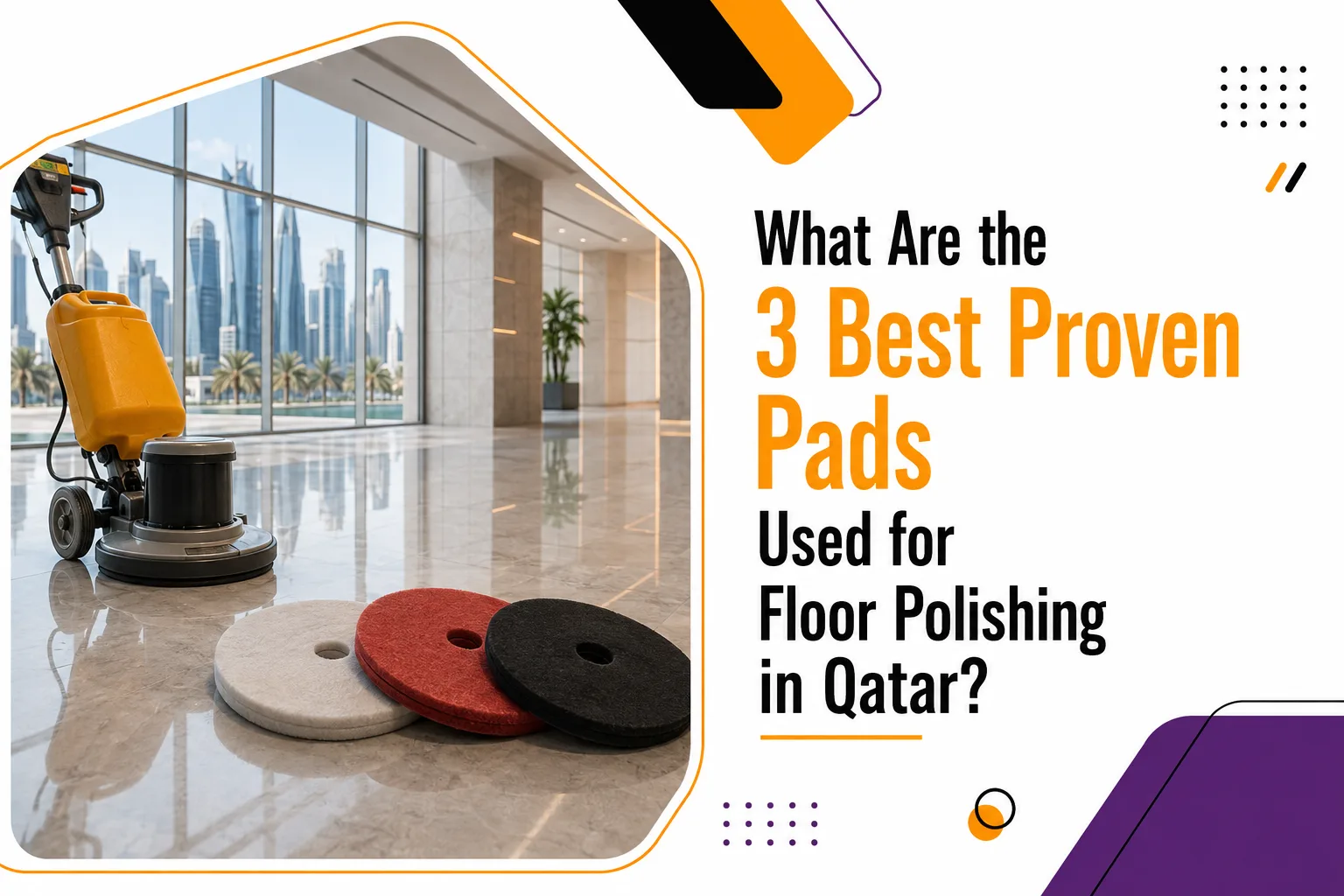
Entering a showroom, villa, or lobby with stunning marble or tile floors and discovering scratches, hazy streaks, and dull patches that catch the light in all the wrong places is the most frustrating thing. Most of the time, this deterioration was not caused by aging or excessive foot activity. It resulted from using the incorrect grit, pad, or cleaning or polishing method.
Almost no one discusses this aspect of floor polishing in Qatar, despite the fact that it is the primary distinction between a floor that appears recently restored and one that appears permanently damaged. The pad is equally as important as the machine, the chemical, or the person who is using it.
In this guide, we will break down the three proven pad categories that professionals actually use, how grit progression works, what a proper hard floor deep clean looks like before polishing even begins, and how to avoid the mistakes that ruin marble and tile every single day across Doha’s homes and businesses.
Why Pad Selection Matters in Floor Polishing
Marble, natural stone, and expensive tile are surprisingly sensitive once you get below the top layer. When exposed to high light or direct sunshine, a single pass with the wrong pad might cause micro-scratches that are invisible at first but show up a few days later. Because of these factors, professional floor cleaning in Qatar is a skilled trade rather than merely a mop-and-buff job.
In reality, the pad is what actually comes into contact with the stone. The machine just spins it. The pad will grind away material unevenly if it is too forceful for the type of floor. It just moves dust and wastes time if it is too gentle. The difference between a floor that appears brand new and one that looks worse than before the work began is making this one choice correctly.
The Top 3 Reliable Pads for Floor Polishing in Qatar
Professionals use three core pad kinds, each intended for a certain stage or surface type. Knowing what each one performs makes it easier to understand why effective floor polishing in Qatar never employs just one pad.
1. Diamond Grinding Pads for Marble Restoration Doha Projects
The foundation of any significant marble restoration project in Doha is diamond pads. They are embedded with real diamond particles at several grit levels, from extremely fine, which creates that glass-like brilliance to extremely coarse, which removes severe scratches and etching.
Water serves as a lubricant and a means of flushing away the ground-down stone particles when these pads are used wet. To adequately restore dulled or scratched marble without causing further harm, they are usually applied in a sequential manner, beginning coarsely and working their way up to finer grits.
Diamond pads are beneficial for:
- Removing deep scratches, etch marks, and water stains from marble
- Leveling out areas of natural stone that are weathered or uneven
- Bringing back the shine of marble that has been worn down over time
- Preparing the surface before a final buffing stage
2. Buffing and Polishing Pads for Shiny Tile Wash Results
Buffing pads take over once diamond pads have leveled and polished the stone or tile. They are used with a polishing compound instead of a raw grinding action, are softer, and are frequently composed of blends of wool, microfiber, or synthetic fibers.
The mirror-like, shiny tile wash finish that customers notice right away is really produced at this stage. Diamond pads remove material more effectively than buffing pads. Rather, they close tiny pores and maximize reflectivity by burnishing the surface.
Typically, the choice of buffing pads depends on:
- The level of hardness of the tile or polished stone
- Whether you go for a matte, satin, or high-gloss finish
- The kind of polishing compound being applied in conjunction with the pad
- Whether the floor requires regular maintenance passes or a one-time shine
3. Sanding Screens and Pads for Wood Floors
Not every Doha property has a marble or tile finish. Sanding pads and abrasive screens are used in villas, workplaces, and residential units with hardwood or engineered wood flooring, which require a whole new strategy.
Stone polishing and wood floor sanding employ entirely different grit logic. In order to prepare the wood for staining or sealing, it begins aggressively to remove surface damage, scratches, and outdated finishes before moving down to even finer grits. Dust extraction is necessary to avoid obstructing the grain or leaving residue underneath the new finish because wood, unlike stone, is sanded dry.
The following sanding pads are commonly used in wood floor restoration:
- Coarse-grit screens to remove deep scratches and outdated finishes
- Medium-grit pads for evening out the surface after stripping
- Fine-grit pads for the final smoothing pass before sealing
- Buffer screens used between coats of finish for adhesion
How Pad Grit Progression Works
Clients frequently wonder why a technician utilizes multiple pads rather than just one. The process of grit progression provides the answer, and skipping steps is one of the easiest ways to ruin a floor.
- Coarse grit: Coarse grit eliminates the worst damage, including deep scratches, etching, accumulated old wax, and seriously damaged finish.
- Medium grit: The coarse pad’s imprints are evened out by medium grit, further smoothing the surface.
- Fine grit: Any haze from the previous stage is eliminated by using fine grit to further refine the surface.
- Polishing or buffing stage: This process provides the final shine to stone, tile, or sealed wood.
Because the scratches from the coarser pad were never completely smoothed out, skipping a stage in this process, such as moving straight from coarse to polishing, almost always results in apparent swirl marks or a hazy finish. The most frequent technical error in inexperienced floor polishing projects in Qatar is this one, which is also the easiest to avoid with the right technique.
Why Polishing Should Come After a Deep Clean of a Hard Floor
One of the quickest ways to collect grit, sand, and other debris below the pad is to polish directly over a dirty floor. This causes the pad to function like sandpaper and further harm the surface. For this reason, before any grinding or buffing is done, a proper hard floor deep clean should always be done.
Typically, a thorough pre-polish clean includes:
- Eliminating all surface dust, sand, and debris using a dry vacuum
- Extensive cleaning to get rid of dirt embedded in grout lines and stone pores
- Elimination of any old wax, sealant, or coating that would prevent polishing
- Allowing the floor to fully dry before any pad makes contact
Facilities that skip this stage and proceed directly to polishing frequently have to pay for the project twice. Once for the hurried polish that scratched the surface and trapped debris, and again for the necessary rectification work.
Typical Errors That Damage Tile and Marble Floors
The majority of floor damage in Doha residences and businesses is caused by a few common errors found in many floor polishing projects in Qatar, all of which may be prevented with the correct information and tools.
- Applying acidic cleaning techniques on marble. Vinegar, citrus-based cleansers, and many all-purpose sprays almost instantly etch natural stone, leaving dull spots that require expert restoration.
- Skipping grit stages during polishing. As covered above, jumping from coarse to fine leaves visible scratch patterns instead of a clean finish.
- Using the wrong pad speed or pressure. Too much pressure with an aggressive pad on soft stone can gouge the surface permanently.
- Polishing over unremoved dirt or sand. This traps abrasive particles under the pad, causing fresh scratches during the very process meant to remove old ones.
- Ignoring furniture pads and floor protection. Dragging furniture or heavy equipment across a freshly polished floor undoes weeks of maintenance in seconds.
Comparison Table: Which Pad Works Best for Which Floor
Floor Type | Recommended Pad | Primary Purpose |
Natural marble | Diamond grinding pads | Scratch removal, leveling, shine restoration |
Polished tile | Buffing/polishing pads | Final gloss, maintenance shine |
Textured or matte tile | Medium buffing pads | Even sheen without excess gloss |
Floors made of hardwood | Coarse to fine sanding screens | Strip old finish and prepare for sealing |
Engineered wood | Sanding pads with fine grit | Refinishing lightly without sanding excessively |
Terrazzo | Diamond pads (all grits) | Full restoration and high-gloss finish |
Choosing a Floor Polishing Near-You Provider
If you are searching for floor polishing near you in Doha or anywhere else in Qatar, the provider you choose matters just as much as the pads and equipment they use. Quality floor polishing in Qatar depends heavily on the team behind the machine, so look for these signs of a genuinely capable provider:
- They ask about your floor type before quoting a price. Marble, porcelain tile, and wood all require completely different approaches, and a provider that quotes without asking is a warning sign.
- They explain their grit progression process. A technician who can walk you through coarse-to-fine staging clearly understands the craft.
- They test a small section first. Before committing to a full-floor treatment, reputable providers frequently test a discrete section.
- They have the appropriate sanding, buffing, and diamond pads on hand. A team is inadequately equipped to deal with mixed flooring if they arrive with just one kind of pad.
- They offer aftercare guidance. In between professional treatments, experienced providers teach how to preserve the shine and prevent damage.
How Adonai Solutions Handles Floor Polishing in Qatar
Since 2016, Adonai Solutions has been providing expert floor polishing in Doha’s residences, workplaces, shops, and commercial buildings. Instead of using a one-size-fits-all strategy, the team employs the entire line of diamond grinding pads, buffing pads, and sanding equipment required to effectively handle marble, tile, terrazzo, and hardwood flooring.
Before any grinding or buffing is done, every project begins with an evaluation of the material and condition of the floor, followed by a thorough hard floor deep clean to get rid of any embedded debris. The team then proceeds with the proper grit progression for the surface, which might be a total wood floor sanding and refinishing for a villa, a simple shiny tile wash and polish for a store location, or full marble restoration work in Doha for a scratched lobby floor.
Before any work is done, Adonai Solutions can evaluate the surface and suggest the best restoration strategy if your floors have developed scratches, lost their shine, or just have not undergone professional maintenance in a long time.
Conclusion
The choice and procedure of the pads is nearly always the difference between a floor that appears to have been recently restored and one that appears to be permanently damaged. The majority of marble and tile damage is really caused by skipping procedures or using the incorrect one. Diamond grinding pads, buffing and polishing pads, sanding pads, and screens all play different roles.
Making a floor shine for a day is only one aspect of proper floor polishing in Qatar. It entails using the appropriate grit gradation, thoroughly cleaning before starting any grinding, and avoiding the common mistakes that cause early dulling and scratching. Whether you are dealing with worn-out tile floors, cracked marble, or hardwood that has lost its shine, the right pads and the right process can make all the difference between a temporary fix and a thorough restoration.
Get Professional Floor Polishing Services in Qatar
Restore shine and protect your floors with professional polishing services designed for clean, polished, and lasting results.
Frequently Asked Questions
Which pad is most effective for fixing scratches on marble floors?
Diamond grinding pads are the most often used solution for fixing scratched marble since they are embedded with actual diamond particles that can evenly polish down the stone’s surface. Typically, the deepest etching and scratches are removed with a coarse grit, the surface is smoothed with progressively finer grits, and the shine is restored using a buffing pad and polishing compound. Because attempting to restore scratched marble with a single pad or grit level usually leaves apparent marks, professional marble restoration Doha services always employ a full grit sequence rather than a single pass.
How frequently should flooring made of marble or tile be professionally polished?
The majority of business spaces benefit from professional polishing every six to twelve months, while high-traffic sections like lobbies or retail floors may require care every three to six months. This largely relies on foot traffic. If regular maintenance cleaning is done correctly in between, residential floors with less traffic can frequently last twelve to eighteen months between expert treatments. More regular, lighter maintenance is typically less expensive than infrequent, extensive restoration since waiting too long between polishing sessions allows scratches and dullness to accumulate, which then takes more harsh grit stages to correct.
Why does polishing make my floor appear worse rather than better?
Rather than a defective floor, the issue almost always indicates a process fault. Skipping grit levels, such as moving directly from a coarse pad to a polishing pad without first passing through the medium and fine stages, is the most common cause. This process only partially smoothes out the original scratch pattern, giving it a hazy or swirling appearance. Another common problem is polishing over a floor that has not been well cleaned beforehand. The issue is because trapped dirt and sand act like sandpaper below the pad, creating new scratches as the old ones are being removed. A complete hard floor deep clean before polishing and the appropriate grit sequence can prevent both of these issues.
Are marble or tile polishing and wood floor sanding different?
Indeed, quite a bit. Instead of using a wet polishing solution, wood floors are sanded dry using abrasive screens and sanding pads that go from coarse to fine grit to remove the previous finish and smooth the wood surface. This is followed by staining and sealing. On the other hand, marble and tile polishing is typically done wet, using stone-specific polishing solutions instead of wood fibers and diamond pads. Because it is improper and might cause serious harm to use stone polishing equipment on wood or vice versa, providers of both services need specific tools and expertise for each type of surface.
Can I polish my floors myself, or should I hire an expert?
While simple maintenance cleaning and light buffing can be reasonably done at home with the right equipment, full-scale polishing, including diamond pads, grinding tools, and grit advancement, is best left to skilled specialists. Genuine floor repair equipment is costly, needs to be handled carefully to prevent cutting sensitive stone, and requires a long-term grasp of grit sequencing. Without this experience, homeowners who attempt do-it-yourself grinding on marble frequently wind up with uneven, hazy, or scratched results that subsequently require professional correction, which usually costs more than engaging a skilled provider from the beginning.
What causes dull, cloudy patches on marble floors even after cleaning?
Dull or cloudy patches are usually a sign of surface etching rather than dirt, and no amount of regular cleaning will remove them because the damage has already occurred at the stone’s surface level. Etching happens when acidic substances, such as vinegar, citrus juice, or certain all-purpose cleaners, come into contact with marble and react with the calcium carbonate in the stone. The only way to correct this is through a proper diamond pad grinding and polishing sequence that removes the etched layer and restores a smooth, reflective surface, which is a core part of the professional work of marble restoration in Doha.
How do I find a reliable provider for floor polishing near me?
Start by asking whether the provider evaluates your specific floor type before quoting a price, since marble, tile, and wood all require different pads, techniques, and processes. A reliable team should be able to explain their grit progression clearly, mention that they perform a hard-floor deep clean before any grinding begins, and ideally offer to test a small section of the floor first. It also helps to ask what equipment they bring, since a provider limited to only one type of pad is not properly equipped to handle mixed flooring, and to request examples of previous restoration work on floors similar to yours before committing to a full project.