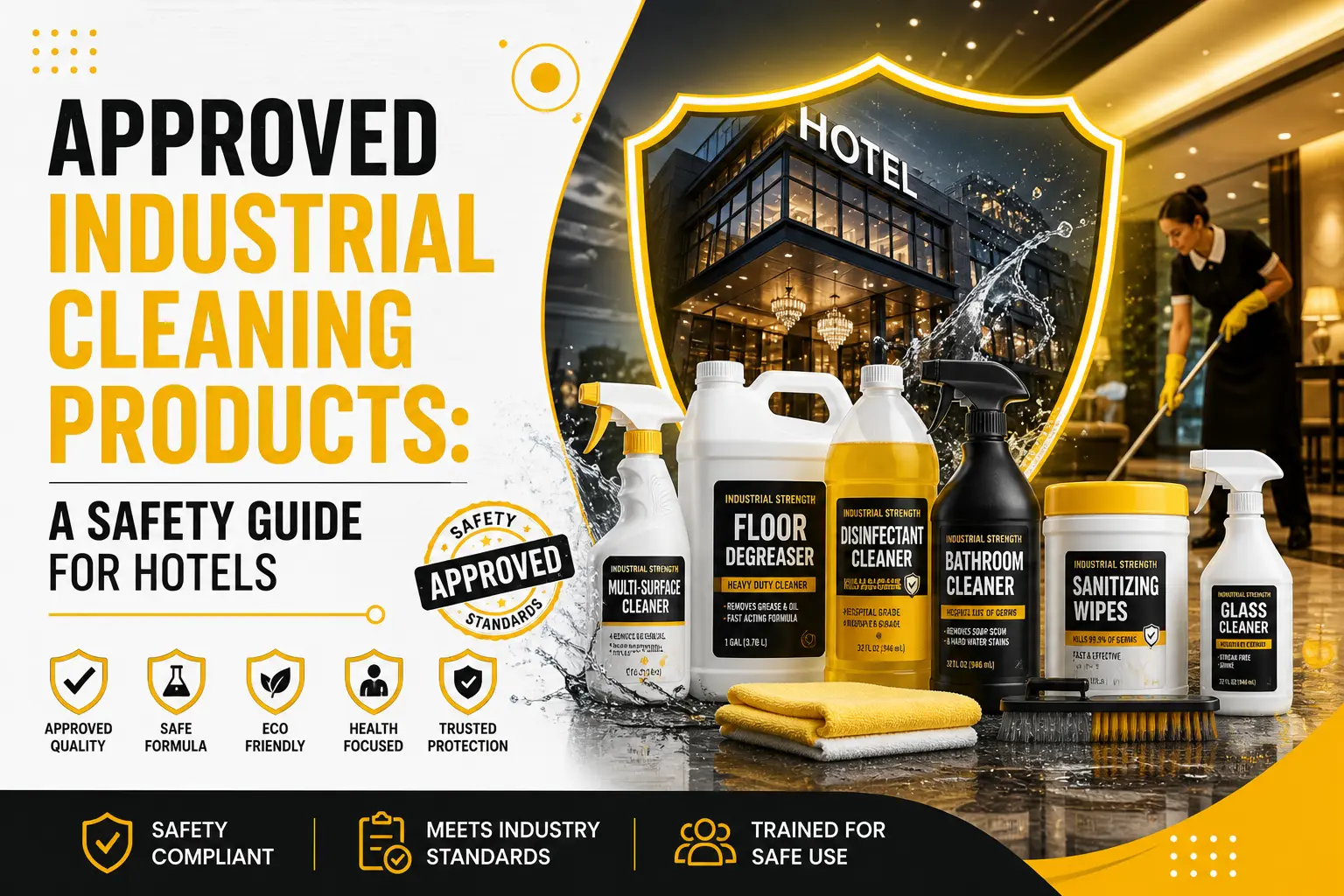
In 2026, keeping a hotel spotless is not just about passing an inspection; it is a high-stakes part of the guest experience. Today’s travelers equate clinical-level cleanliness with luxury, and they are not shy about checking corners. With the global hospitality cleaning market hitting a massive $484.1 billion this year, the industry is moving away from basic, “one-size-fits-all” sprays. Instead, smart operators are building specialized housekeeping chemical lists that pair heavy-duty results with eco-friendly cleaning credentials.
Running a major property requires industrial-grade power that retail products just cannot match. Whether you oversee a boutique in Msheireb or a sprawling resort in Lusail, you must perfectly match your chemical inventory to your specific surfaces.
One mistake, like using the wrong acid on expensive marble or harsh bleach on high-end fixtures, can cause permanent damage, put your team’s health at risk, or even lead to an immediate shutdown by municipal inspectors.
This guide shows you how to build a high-performance housekeeping chemical list that keeps your hotel hygiene standards elite. We will help you select industrial cleaning products that deliver results while staying fully compliant with Qatar’s strict safety regulations and moving toward eco-friendly cleaning measures.
The Reality of Modern Hotel Hygiene
The label “industrial cleaning products” is not just marketing; it is a performance guarantee that a product can kill dangerous pathogens on contact. Busy spaces such as hotel gyms and entrance lobbies see constant contact throughout the day, with guests and staff touching shared surfaces repeatedly. Maintaining safety in high-traffic zones demands deep disinfection routines that go well beyond a quick surface wipe intended only to make things look “neat.”
In Qatar, the Ministry of Municipality and Health officials closely monitor compliance with strict legal obligations to achieve elite hotel hygiene standards. Because inspectors can arrive for unannounced site visits at any time, you cannot afford to take shortcuts; your property must be audit-ready at all times. This means every single agent on your housekeeping chemical list must carry the official approval and registration required by national health and environmental laws. If a product is not properly registered, it should not be on your property.
Choosing the right supplies really comes down to the science of the surface. For example, a heavy-duty acidic descaler is great for clearing a blocked pipe, but if it touches a luxury gold faucet, it will instantly eat through the PVD finish and ruin the fixture.
This risk is exactly why many local GMs now partner with Adonai Solutions. Their teams conduct deep-dive inventory audits to ensure housekeeping crews are not using abrasive agents that eat away at expensive assets. This level of oversight helps luxury hotels keep their finishes looking brand new while hitting the “medical-grade” cleanliness guests expect.
See Also: Looking for low-maintenance commercial flooring? Discover the elegance of our premium vinyl carpets in Qatar.
Key Categories for Your Housekeeping Chemical List
Solid facility management relies on picking the correct tool for the job. To stop cross-contamination and protect surfaces, supplies should be sorted by their specific location and function.
Multi-Surface and All-Purpose Cleaners
Best for daily dusting and light dirt, these must stay pH-neutral to safeguard materials like wood and metal found in guest suites.
Heavy-Duty Degreasers
Built for back-of-house and kitchens, these liquids dissolve the tough grease and burnt residue common in active cooking zones.
Glass and Mirror Cleaners
Fast-evaporating, ammonia-free or alcohol-based formulas keep windows and mirrors sparkling and free of any visible streaks.
Sanitizers and Disinfectants
Applied to high-contact spots like knobs, buttons, and remotes, these agents halt germ transmission when used correctly.
Climate-Specific Products
For Qatar’s unique weather, cleaners must fight fine desert dust and block mold growth in humid laundry or spa areas.
Stone and Marble Care Solutions
Marble and other natural stone surfaces require neutral cleaners to maintain their appearance and avoid surface damage.
Color-Coded Labeling Systems
Using designated colors for different zones, such as red for restrooms and blue for glass, helps staff select the correct product and reduces the chance of mistakes.
The Approved Inventory: What You Actually Need
Your inventory should prioritize industrial cleaning products in doha that are globally respected but also locally approved for use in Qatar. A standard professional housekeeping chemical list should include:
- Quaternary Ammonium Disinfectants: The gold standard for room hygiene and broad-spectrum germ-killing.
- Hydrogen Peroxide Cleaners: A better, safer alternative to bleach that brightens surfaces without the choking chemical smell.
- Neutral pH Floor Cleaners: Essential for limestone and marble, ensuring you clean the stone without stripping the sealant.
- Heavy-Duty Alkaline Degreasers: Specifically for the grease-heavy environment of commercial hotel kitchens.
- Acidic Descalers: Vital for removing the hard-water scale caused by Doha’s mineral-rich water supply.
- Encapsulation Carpet Cleaners: A low-moisture system that traps dirt in crystals, allowing for faster dry times and quicker room turnover.
- Oxygenated Laundry Detergents: Heavy-duty soaps that guarantee linens are sanitized even in energy-saving cold cycles.
We are also seeing a massive shift toward eco-friendly commercial cleaning chemicals. Many of these industrial cleaning products now come in citrus or plant-based versions. These are much easier on the lungs of your housekeepers, and Adonai Solutions often helps hotels bridge the gap between old-school chemicals and these safer, modern alternatives.
Read Also:
- LED Energy Savings in Qatar: How Much Can You Save on Electricity?
- Split AC Placement: Best Wall Positions for Optimal Cooling
- Moving AC Units: Pump Down Procedures to Prevent Damage
- Industrial Power Strips in Doha and How to Avoid 10 Workplace Hazards
Tech-Driven Hygiene Trends in 2026
Cleaning is no longer just a manual labor job; it is becoming a digital science. In Qatar, five-star hotels are now treating hotel hygiene standards as a verifiable data point.
“Predictive cleaning” is the new standard. Instead of cleaning a lobby every hour on the dot, hotels use occupancy sensors to figure out which areas actually need attention. Adonai Solutions is at the forefront of this trend in Doha, implementing systems that monitor chemical use in real time. This saves money on wasted products and keeps your team focused on the areas with the highest foot traffic.
Smart PPE and Employee Safety in the Heat
The equipment your staff wears is also evolving. In Qatar’s intense heat, taking care of your team is not just a legal requirement; it is the right thing to do. In 2026, “Smart PPE” is how we are making that happen.
We are talking about heat-sensing wearables sewn into uniforms to catch heatstroke before it happens, and reactive safety gloves that change color the moment they touch a chemical spill. For those tough jobs, portable PAPR hoods keep workers cool with a steady stream of filtered air, while lightweight exoskeletons take the literal weight off a housekeeper’s back.
Investing in this gear shows that “sustainability” is about people, not just planets. When your staff is not exhausted or overheating, they are much more likely to hit those elite hotel hygiene standards every single time.
The Death of the Paper Safety Binder
The old “yellow binder” full of safety sheets is no longer used. Qatari law now pushes for digital Safety Data Sheets (SDS). This allows your team to access vital info on their phones instantly.
- QR Codes on Bottles: One scan shows first-aid steps and mixing ratios immediately.
- Cloud Updates: No more manual printing; the system updates itself whenever a formula changes.
- Native Language Support: Staff can read safety instructions in their language, preventing dangerous mistakes.
Digital systems make government inspections incredibly easy and ensure no one is ever “guessing” how to handle a chemical spill.
Sustainability and Probiotic Cleaning
Under Qatar National Vision 2030, eco-friendly industrial cleaning products for commercial facilities in Doha are now a benchmark for luxury. It is not just about the planet; it is about air quality. Standard detergents leak fumes that trigger guest migraines. Swapping to faint-scent, green-label liquids ensures rooms feel crisp instead of “bleached.”
We are also seeing the rise of “living” cleaners. Probiotic cleaners use beneficial bacteria that stay on a surface and keep “eating” dirt for days after the housekeeper has left. Similarly, antimicrobial coatings on elevator buttons provide a 24/7 layer of defense. Adonai Solutions helps local hotels test these new coatings to see how they handle the intense Qatar dust.
Logistics and Local Sourcing
In Doha, even the best cleaning plan can fail if your supply chain is not reliable. You need to work with local vendors who actually know the Qatari market; that is the only way to avoid those massive customs headaches at the border that can freeze your entire operation.
Keeping a stash of extra supplies on hand is, honestly, just common sense for any manager. By keeping a solid buffer in the storeroom, you make sure your team is not left panicking, whether you have suddenly been hit with a fully booked weekend or a surprise visit from the Ministry of Public Health inspectors.
This buffer allows you to uphold elite hotel hygiene standards without the stress of last-minute scrambles. Staff preparation completes the equation. When you invest in cleaning chemicals, you are not simply purchasing products; you are putting an entire operational system into place.
Adonai Solutions runs workshops on the “Sinner’s Circle,” balancing chemical strength, heat, time, and physical scrubbing. This ensures your team knows exactly how to get rid of desert grime without damaging your property.
Conclusion
In the Qatar hospitality world, your reputation depends on the details guests never see. They might not notice a perfect room, but they will never forget a dirty one. Your brand is defined by the choices you make, from kitchen degreasers to smart PPE for your staff.
Partnering with a local expert like Adonai Solutions gives you the specific knowledge needed to stay ahead. They turn “cleaning” from a chore into a precise science. In a market as competitive as Doha, the hotels that invest in this level of detail are the ones that will win the loyalty of the world’s most demanding travelers.
Keep Your Hotel Safe with a Professional Cleaning Solution
Ensure hotel hygiene and safety with approved industrial cleaning products and expert support in Qatar.
Frequently Asked Questions
What are industrial cleaning products?
industrial cleaning products, including degreasers, solvents, descalers, and disinfectants. These are used in industrial and manufacturing facilities. They are formulated to get rid of grime, oil, and bacteria. The formula is stronger than regular cleaners used for cleaning at home.
What are R1, R2, R3, R4, and R5 in housekeeping?
The housekeeping chemical list is classified into different categories using this coding system. R1 is for bathroom cleaning, R2 is for hard surfaces, R3 is used for cleaning glass, R4 is for furniture polish, and R5 is for air freshening.
How many types of chemicals are in housekeeping?
Housekeeping typically is made up of detergents, degreasers, disinfectants, and abrasives. These are used alongside deodorizers to sanitize surfaces and remove stains.
What is eco-friendly cleaning?
Eco-friendly cleaning involves relying on methods and products that do not harm human health or the environment. The cleaning products are made of non-toxic, biodegradable, and sustainable materials.
What is the basic hygiene in a hotel?
Basic hygiene in a hotel refers to the removal of dirt and bacteria through regular surface disinfection, laundering linen, and thorough cleaning of rooms. Lobbies, elevators, and other areas that get high traffic should be meticulously cleaned. Strict protocols regarding food handling should be in place.