
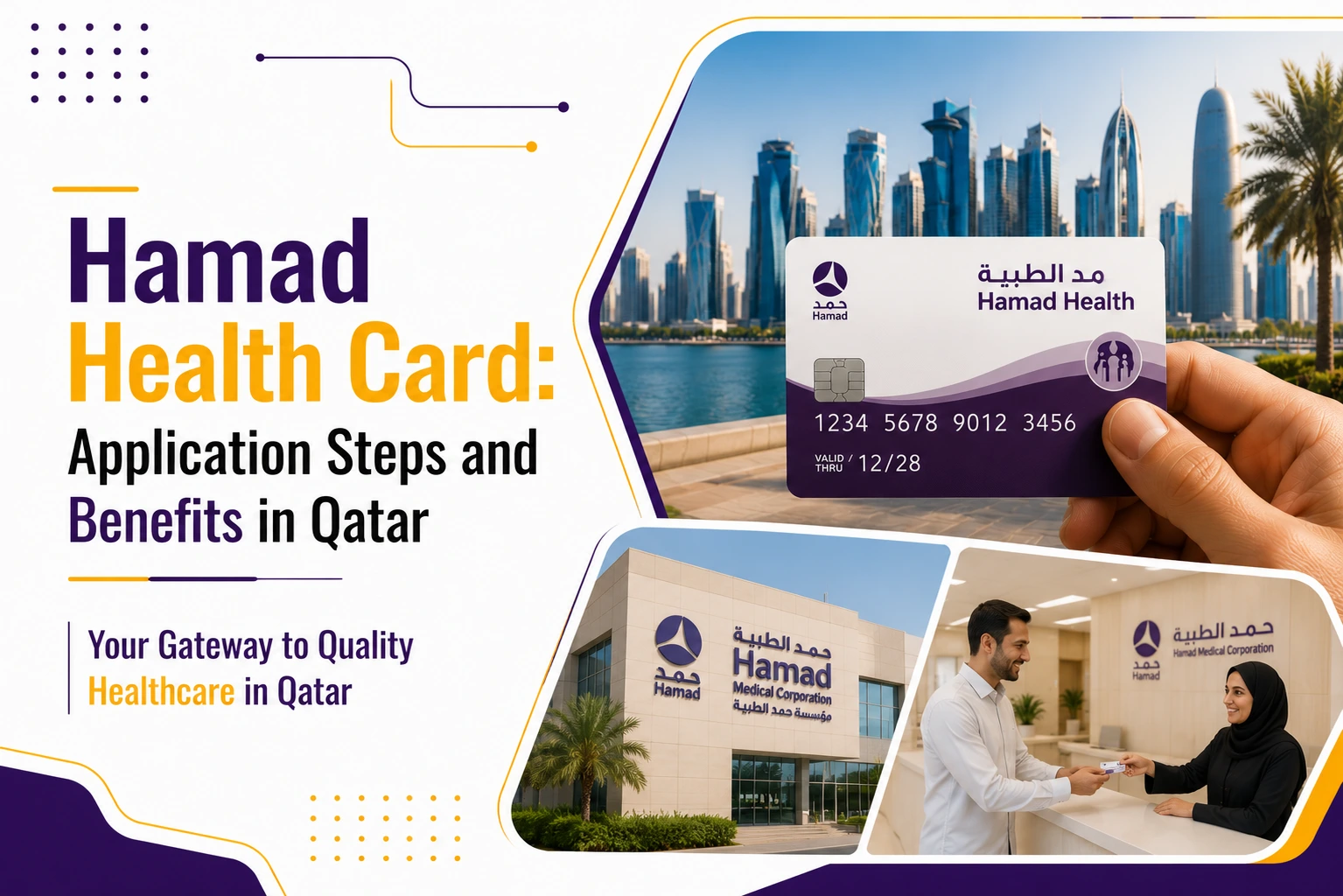
No matter how long you have been in Qatar or how recently you arrived here, you cannot afford to put off getting the Hamad Health Card. Without it, a hospital stay can become an extremely stressful bill, and a simple clinic visit can cost you many times more than it should. It gives you access to some of the most reasonably priced medical services available in the area.
Everything you need to know about the Hamad Health Card in Qatar is covered in this article, including what it is, who needs one, how much it costs, and how to complete your HMC card application or medical card renewal without going to a health center. We will also touch on where the Hamad Health Card fits into Qatar’s wider public healthcare system, so you understand what you are actually paying for.
What Is the Hamad Health Card?
The official document issued by Hamad Medical Corporation (HMC) that grants citizens and residents access to discounted medical care throughout the nation’s public healthcare system is known as the Hamad Health Card, or simply the Qatar Health Card. It is your pass to the government-run public healthcare Qatar system, which includes everything from emergency care at HMC hospitals to expert consultations and routine exams at your local Primary Health Care Corporation (PHCC) center.
Consider it more of a membership pass to the public system than insurance. It does not cover private hospitals, and it will not pay out like a private insurance policy would. What it does is unlock heavily discounted rates at government-run facilities, which for most families in Qatar ends up being the more practical and far more affordable option day to day.
Private Insurance vs. Hamad Health Card
It is important to understand the distinction between the two since people frequently mix them together. Private insurance is a paid plan that covers expenses at many hospitals, including private ones, and is typically set up through your employment. The Hamad Health Card is a government scheme tied to your identity in Qatar, and it applies specifically to public facilities. In actuality, many residents use the Hamad Health Card as a low-cost backup for daily care, prescription medications, and public hospital treatment in addition to private insurance for speed and flexibility.
Is a Hamad Health Card Required in Qatar?
Although the regulations vary slightly based on your status, almost every resident of the nation benefits from having one.
- Expatriate residents holding a Qatari residency permit (QID) are expected to hold a valid health card to access subsidized services.
- GCC nationals living in Qatar can apply for the card to receive the same discounted rates as residents.
- Domestic workers are eligible and pay a reduced fee compared to standard expatriate residents.
- Children and dependents on a family sponsorship also need their own card, issued using their guardian’s documentation.
- Qatari citizens are increasingly moving toward using their Qatar National ID directly for healthcare access, following recent regulatory updates (more on that below).
An HMC card application should be on your to-do list within your first few weeks in the nation if you fit into any of the first four categories. You should not begin the paperwork until you truly need a doctor.
Key Benefits of the Hamad Health Card
When you compare a subsidized bill with a non-subsidized one, the value of the Hamad Health Card becomes clear. What cards are usually received are as follows:
- Significant savings on consultations and treatments in PHCC health centers and HMC hospitals, frequently a small portion of what non-cardholders spend.
- PHCC health facilities provide free or inexpensive care for most common medical requirements, including immunizations, general examinations, and minor diseases.
- Access to specialist referrals via the public system, preventing you from having to navigate hospital departments by yourself.
- Discounted prescription drugs at government pharmacies, which can be a significant expense if you or a family member requires regular prescriptions.
- Access to emergency care at HMC facilities is a crucial safety measure in case of unexpected mishaps or medical emergencies.
- A single medical record that follows you between PHCC facilities and HMC hospitals makes referrals and follow-ups go much more smoothly.
- The card is nationwide, so it functions the same whether you are in Doha, Al Wakrah, Al Rayyan, or any other part of Qatar.
This system is precisely the kind of structure that prevents healthcare from becoming a financial burden for working families in a nation with a sizable expatriate community.
Hamad Health Card Fees in Qatar
This card’s affordability in comparison to what it unlocks is one of its best features. Fees differ slightly depending on the type of residency:
Category | Fee for a New Card or Renewal | Replacement Cost (Expired or Lost) |
GCC and Qatari nationals | QAR 50 | QAR 100 |
Domestic workers | QAR 50 | QAR 100 |
Other expatriate residents | QAR 100 | QAR 200 |
Payment is generally required by credit or debit card, whether you are applying online or visiting a health centre in person. Most centres no longer accept cash for this transaction, so bring a card with you.
Given that a single non-subsidised specialist visit can cost several times the annual fee, the Hamad Health Card in Qatar pays for itself on the very first visit.
Documents Required for the HMC Card Application
Before you head to a PHCC center or log into an online portal, gather the following:
- Valid Qatar ID (QID) original and a copy
- Passport copy (for reference and verification)
- A recent passport-sized photograph
- In certain situations, a utility bill or proof of residency
- Details about the sponsor or employer, if any
- Method of payment (debit or credit card)
You will also require the sponsor’s paperwork and the QID of any dependents, such as spouses or children. Having everything ready before you start your HMC card application will save you the most time. The majority of delays are caused by people forgetting their payment card or showing up with a duplicate of their QID that has expired.
How to Apply (Step-by-Step) for the Hamad Health Card
There are two practical options, which are visiting a PHCC health center in person or doing it online from your phone. Both are straightforward once you know what to expect.
Applying Online
For most people, the online application is the fastest route, and it is open 24/7.
- Install the Metrash2 or Nar’aakom app on your phone, or access the Hukoomi government services portal.
- Log in using your QID and Qatar National Authentication System (NAS) credentials.
- Select the health card service from the menu.
- Enter or confirm your personal details, which the system usually pulls automatically from your QID.
- Upload the required documents if requested.
- Use a credit or debit card to pay the relevant fee.
- After submitting the request, you will usually receive a confirmation either immediately or in a few hours.
Once your card is active, you may usually plan your first PHCC visit immediately because online applications are integrated with the appointment booking system.
Applying In Person
If you would rather have someone walk you through it or you run into an issue online, visiting a health center works just as well.
- Locate your nearest PHCC health center or HMC patient services desk.
- Take a queue number for health card services.
- Submit your documents and personal details to the counter staff.
- Pay the fee by card.
- Depending on the center’s workload, you may get your card the same day or in a few working days.
It is worthwhile to double-check your paperwork before leaving the house because in-person visits typically take 20 to 30 minutes if you come with the proper documentation.
Medical Card Renewal in Qatar
Your Hamad Health Card is valid for one year for most expatriate residents, and it does not display a visible expiry date on the card itself. This catches many people off guard, since there is nothing physical prompting them to renew.
The safest habit is to check your status online periodically rather than waiting for a rejected claim at a hospital counter.
Checking Your Expiry Date
You can check your card’s status anytime through the Hukoomi portal or the Nar’aakom app by entering your QID and health file number. This takes less than a minute and saves you the trouble of an unnecessary trip to a center.
Online Medical Card Renewal
The fastest way to renew is through the same digital channels used for a new application.
- Log into Hukoomi or Nar’aakom with your QID.
- Select the renewal option under health card services.
- Confirm your details are still accurate.
- Pay the renewal fee by card.
- Your expiry date updates immediately, and your existing card typically remains usable while the system processes the update.
In-Person Medical Card Renewal
If you prefer face-to-face service, or your details have changed significantly, visiting a PHCC center works too. Bring your QID, your old card if you still have it, and your payment method. The renewed card or updated record is generally ready the same day.
In any case, schedule the renewal of your medical card on a calendar and treat it similarly to renewing your driver’s license or QID. The system would not pursue you if it expires.
What Changed: Your QID and Public Healthcare Access
To avoid being taken off guard, it is important to grasp the current state of Qatar’s healthcare system, which has been moving toward digital-first identification.
The Ministry of Public Health declared in September 2025 that a separate physical health card is no longer required for the citizens of Qatar. Their Qatar National ID now serves as proof of coverage directly at HMC and PHCC facilities. By April 2026, this same convenience extended to residents as well, meaning many expatriates can now present their QID at the counter instead of a physical card.
The thing that people miss is that residents still need to renew their digital health card records and pay the related annual fee despite this change. The physical card may be optional to carry, but the underlying registration and payment obligation has not gone away. In other words, your medical card renewal duty is still very real, it is just less about a plastic card and more about keeping your digital record active in the system.
Common Mistakes People Make During Their HMC Card Application
The majority of delays people encounter are caused by a few persistent problems:
- Allowing the card to expire without realizing it because the expiration date is not clearly displayed on it.
- Showing up without a functional debit or credit card because cash is no longer frequently accepted.
- Submitting an application using a QID copy that is out of date and does not correspond with the current residency information.
- Forgetting dependents’ documentation, which stalls family applications at the counter.
- Confusing the health card with private insurance, then being surprised it does not cover private hospitals.
- Assuming the QID update removes the fee obligation, when in fact renewal payments are still required.
Avoiding these is mostly about preparation, as a five-minute document check before you leave home saves a wasted trip.
How Adonai Solutions Can Help
Between work, family, and everything else on your plate, chasing down government paperwork is rarely anyone’s idea of a good afternoon. This is precisely the kind of task Adonai Solutions handles as part of its PRO services in Doha.
Our team manages Top Health Card Applications and renewals on behalf of individuals and companies across Qatar, along with related documentation such as residence permits, ID renewals, and sponsorship changes so you do not have to take time off work to stand in a queue.
If you would rather hand off the entire process, Adonai Solutions’ PRO services team can handle your Hamad Health Card application or renewal, as well as any other government documentation your family or business needs in Qatar.
Conclusion
The Hamad Health Card remains one of the best value-for-money documents you can hold as a resident of Qatar. It provides access to a full year of subsidized care at HMC hospitals and PHCC health clinics around the country for a price that hardly covers a single private clinic visit. It only takes a few minutes to complete the application on your phone, and once your information is on file, renewal is even quicker.
The one thing to watch is the lack of a visible expiry date, so build a habit of checking your status through Hukoomi or Nar’aakom rather than waiting for a surprise at the hospital counter.
One of the easiest methods to safeguard your health and finances in Qatar is to take care of this as soon as possible, whether you do it yourself or assign it to a PRO services team.
Get Professional Support for Your Hamad Health Card Application
Apply for your Hamad Health Card with expert assistance and enjoy fast, hassle-free processing in Qatar.
Frequently Asked Questions
What is a Hamad Health Card used for?
The public healthcare network in Qatar, which consists of Primary Health Care Corporation facilities and hospitals run by Hamad Medical Corporation, offers residents and citizens access to subsidized medical services through the Hamad Health Card. You pay much less for consultations, specialist referrals, emergency care, and prescription drugs when you have a valid card than when you lack one. Additionally, it connects your medical information across locations, eliminating the need for you to transport paper records between sessions so that physicians at other sites may access your medical history.
What is the price of the Hamad Health Card in Qatar?
Your residency category determines the fees. For a new card or renewal, Qatari natives, GCC citizens, and domestic workers usually pay QAR 50, while other foreign residents pay QAR 100. The cost of replacing lost or expired cards is usually higher, at QAR 200 for foreigners and QAR 100 for nationals of the Gulf Cooperation Council and Qatar. Both online and at physical health centers, credit or debit cards are nearly always accepted as payment instead of cash.
How do I apply for the Hamad Health Card online?
You can use the Metrash2 and Nar’aakom apps or the Hukoomi government webpage to finish your HMC card application. After logging in with your QID and government authentication credentials, choose the health card service, verify your personal information, upload any required documents, and use a debit or credit card to pay the fee. The system frequently allows you to schedule your first PHCC visit as soon as your card is active, and the majority of online applications are handled promptly or in a few hours.
What is the validity period of the Hamad Health Card, and how can I renew it?
The card is valid for a year after it is issued for the majority of expatriate residents. It is worthwhile to periodically verify your status with Hukoomi or Nar’aakom using your QID and health file number because it does not have a printed expiration date. You can renew your medical card in person at a PHCC health facility with your QID, old card, and payment method on hand, or you can use the same online portals as for a new health card application. Your expiration date is updated very instantly when you renew online, which is usually the quicker alternative.
Do Qatari citizens still need a Hamad Health Card?
As of September 2025, Qatari citizens are no longer required to carry a separate physical health card, since their Qatar National ID now serves as proof of healthcare coverage at HMC and PHCC facilities. This convenience was extended to residents as well starting in April 2026, allowing many expatriates to present their QID at the counter instead of a physical card. It is important to note, however, that residents are still required to renew their digital health card record and pay the applicable fee each year, even if they are no longer carrying a physical card day to day.
Can I use the Hamad Health Card at private hospitals in Qatar?
No. The Hamad Health Card is specifically tied to Qatar’s public healthcare system, meaning it applies to Hamad Medical Corporation hospitals and Primary Health Care Corporation centers only. It does not function like private medical insurance and will not reduce your costs at private clinics or hospitals. Many residents choose to hold both private insurance and a Hamad Health Card, using private coverage for flexibility and faster private appointments, while relying on the health card for affordable everyday care and emergency treatment within the public system.
What documents do I need for the HMC card application?
You will generally need your original Qatar ID along with a copy, a copy of your passport, a recent passport-sized photograph, and a payment card for the applicable fee. If you are applying on behalf of dependents, you will also need their QID and any relevant sponsorship or guardian documentation. Some applicants may also be asked for proof of residency, such as a recent utility bill. Having these documents ready in advance, whether applying online or in person, is the easiest way to avoid delays during the process.