
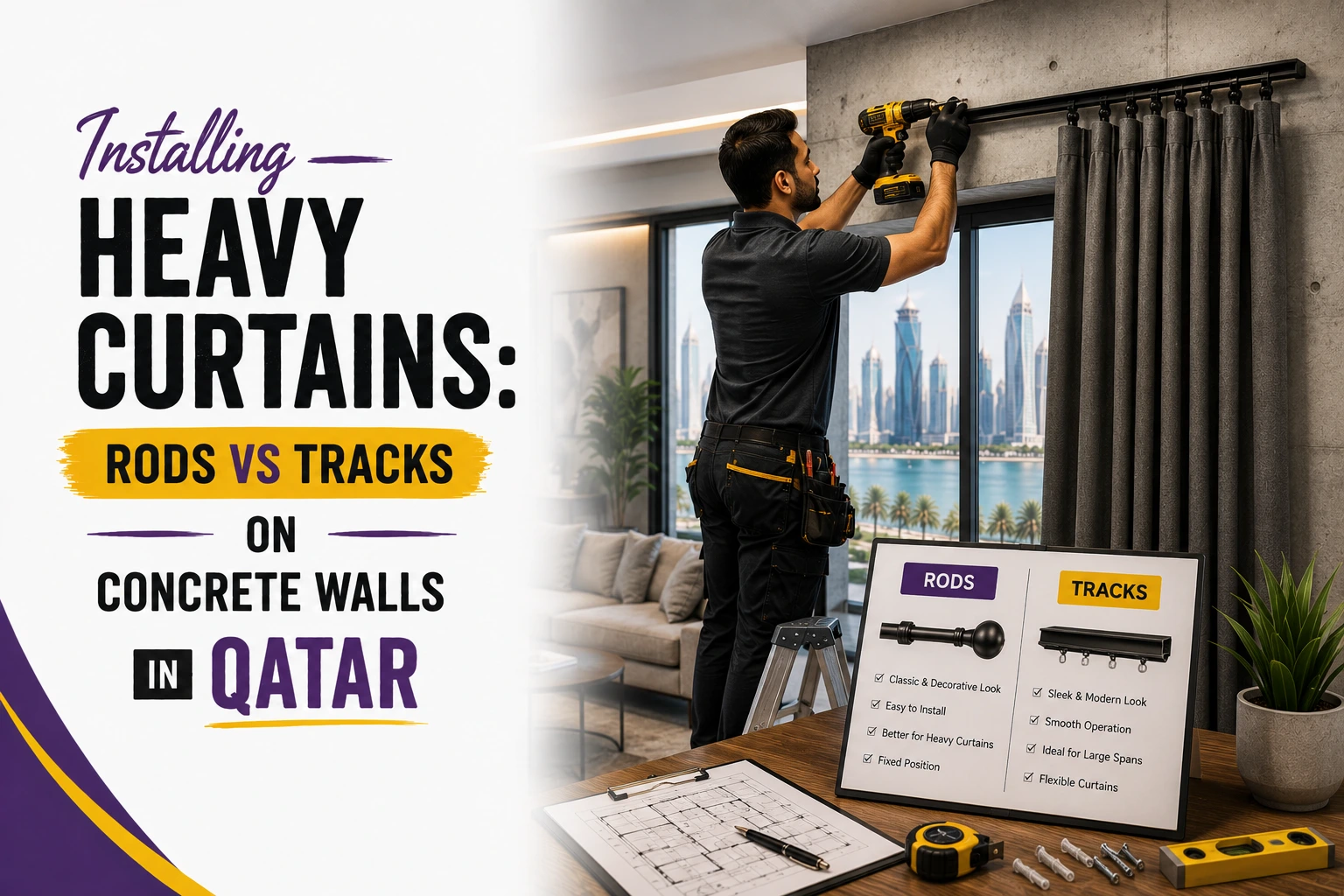
Now that you have finally purchased the blackout drapes you have been admiring for months, you can finally get a decent night’s sleep by blocking out Doha’s persistent afternoon sun. The plastic anchors that came in the package are obviously intended for drywall, not the solid concrete that makes up the majority of walls and ceilings in Qatar, as you discover when you arrive home and examine your wall. This is one of the most common and most frustrating surprises people run into when installing heavy curtains in a concrete-built home.
Concrete construction is the norm here, which means standard installation kits sold with off-the-shelf curtain hardware are often not built for the job. Heavy blackout fabric, thick lined drapes, or double-layer curtains put real weight and pulling force on whatever is holding them up, and a poorly anchored rod or track can fail, sometimes taking a chunk of plaster or concrete with it.
In this guide, we will break down the real differences between rods and tracks for heavy curtains, why concrete lintels specifically require the right hardware, and how to get a safe, secure installation whether you are doing it yourself or calling in a professional. If you are staring at a box of drapes and a wall that looks a lot tougher than your average drywall, this is exactly what you need to read first.
Why Concrete Walls Change the Installation Game
Hanging curtains are quite forgiving in many nations when homes are constructed with plasterboard over metal studs or wood frames. A little nuisance that can be readily repaired is a screw that has been driven into the incorrect location. Concrete is a different story entirely, and it is exactly why installing heavy curtains in Qatar requires a different approach than what most generic hardware instructions assume.
The walls and ceilings of the majority of Doha’s houses and apartments are made of reinforced concrete, which is far more structurally sound but also much less accommodating to drilling and anchoring hardware.
When installing heavy curtains, this is crucial since the weight of the thick blackout fabric plus the daily pulling and adjusting that curtains go through put a lot of strain on whatever is keeping the rod or track in place.
The reason so many do-it-yourself curtain installations finally fail is because standard plastic wall plugs made for lightweight drywall use are just not rated to sustain that combination of weight and repeated stress in a concrete wall.
Which Is Better for Heavy Curtains: Rods or Tracks?
Understanding the true differences between rods and tracks is helpful before getting into anchors and drilling technique. Depending on your curtain type and room configuration, each has genuine advantages. Both methods are frequently used to install heavy curtains, and the best option typically depends on preferred weight and quality.
Curtain Rods
The more conventional choice is a rod, which is usually a wooden or metal pole that grommets or curtain rings move down. They offer a space a more traditional, layered appearance and typically work well with heavier, decorative fabrics.
However, rods typically need strong brackets installed at two or three locations along the wall, and those bracket points must be particularly firmly anchored into concrete since heavy fabric adds a substantial amount of weight along the pole’s length.
Curtain Tracks
Tracks are a more modern, streamlined option, often hidden behind a pelmet or ceiling recess, with curtain hooks or gliders running smoothly along an internal channel. For heavier blackout curtains, tracks are sometimes a better choice because, unlike a normal rod design, the weight is dispersed more evenly over several support brackets along the whole length rather than concentrated at just two or three anchor points. For larger windows or installations that are difficult to access, motorized tracks have also grown in popularity.
Learning About Concrete Lintels and Their Significance
It is likely that you are drilling into a concrete lintel, the structural beam that spans the opening and supports the weight above it, if your curtain installation is taking place above a window or door. Because they are carrying structural weight, lintels are usually built of solid, reinforced concrete, which makes them stronger and more challenging to drill into than a regular wall segment.
This matters for two reasons. First, a hammer drill and certain carbide-tipped bits may be necessary to obtain a clean hole because normal masonry drill bits may not be able to handle the density of a lintel. Second, and perhaps more crucially, lintels may have embedded reinforcing bars, or rebar, which should never be directly drilled into for structural integrity.
This is because striking rebar can quickly damage drill bits or possibly the drill itself. For this reason, before drilling into a lintel area for curtain hardware, experts frequently advise using a detection tool to look for concealed rebar and utility lines.
The Right Wall Plugs and Anchors for Concrete
The anchor you use is arguably the single most important factor in a safe, long-lasting result when installing heavy curtains on concrete. Options generally include:
- Standard plastic wall plugs, suitable only for lightweight curtains and low-stress applications, not recommended for heavy blackout fabric
- Nylon or heavy-duty plastic anchors rated for concrete, offering a stronger hold suitable for medium-weight curtains
- Metal expansion anchors (sleeve anchors), which expand against the sides of the drilled hole for a very secure grip, ideal for heavier curtains and tracks
- Chemical anchors (resin-based), used for the heaviest loads or in situations where maximum holding strength is required, particularly for motorized tracks
- Toggle-style anchors are less prevalent in solid poured concrete but are sometimes utilized in hollow block portions.
It is crucial to match the anchor type to the exact density of your wall or lintel as well as the weight of your drapes. When in doubt, it is usually wiser to size up to a stronger anchor than you believe you need, especially for double-layer or blackout cloth.
How to Safely Install Heavy Curtains on Concrete Step-by-Step
The procedure for firmly installing heavy curtains on a concrete wall or lintel is as follows:
- Mark your bracket positions carefully, using a level to ensure the rod or track will hang straight
- Check for hidden rebar or utilities using a detector tool before drilling, particularly near lintels
- Use a hammer drill with a carbide-tipped masonry bit sized correctly for your chosen anchor
- Drill to the appropriate depth, typically slightly deeper than the anchor length to allow for dust clearance
- Clear dust from the hole thoroughly, since leftover debris can weaken the anchor’s grip
- Insert the suitable anchor for the weight of your curtain and the type of wall you have, gently tapping it into place if necessary.
- Use the proper screw to secure the bracket, being careful not to overtighten, as this could cause the anchor to shatter.
- Confirm the bracket’s stability by applying gentle downward pressure before suspending the full curtain.
The durability of your curtains over months or years of regular use is greatly impacted by taking the time to complete each step correctly rather than hurrying through drilling and mounting.
Typical Errors in Hanging Drapes on Concrete
When installing heavy curtains on concrete walls, even well-meaning do-it-yourself projects encounter inevitable issues. Watch out for:
- Using drywall anchors on concrete, which simply are not rated for the density or weight involved and will eventually fail
- Ignoring the rebar check close to lintels puts structural integrity and tool damage at risk.
- Drilling too shallow weakens the anchor’s holding power and keeps it from seating correctly.
- Overtightening screws can chip the surrounding concrete or break some types of anchors.
- Uneven bracket spacing, leading to sagging curtains or uneven weight distribution over time
- Ignoring curtain weight entirely and utilizing the same lightweight hardware for both heavy blackout drapes and sheer curtains
It usually comes down to matching your hardware and technique to the actual weight and type of wall you are working with, rather than presuming that a single standard solution works for every circumstance, to avoid these common mistakes.
A Brief Comparison of Rods and Tracks
Factor | Curtain Rods | Curtain Tracks |
Best suited for | Decorative, medium to heavy fabric | Heavy blackout and lined curtains |
Weight distribution | Concentrated at bracket points | Spread across the full track length |
Visual style | Classic, visible hardware | Streamlined, often hidden |
Motorization options | Limited | Widely available |
Anchor demands | High at each bracket point | Distributed but more brackets overall |
Typical installation complexity | Moderate | Slightly more involved |
Rather than one technique being ideal for installing heavy curtains in every case, the decision between the two often comes down to the weight of your particular curtains and the overall effect you are trying for in the room.
When to Hire a Professional for Curtain Rail Installation
While some homeowners feel comfortable doing simple drywall installs on their own, concrete work frequently requires a different degree of caution. Consider professional curtain rail installation when:
- You are drilling near a lintel and are unsure how to safely check for rebar or embedded utilities
- You are installing a motorized track, which is frequently used for both structural mounting and electrical installation.
- You have particularly heavy curtains, like floor-to-ceiling drapes or triple-weave blackout cloth.
- You do not have access to a hammer drill or the proper masonry bits since regular drills frequently have trouble with dense concrete.
- You want a guaranteed, warrantied installation, particularly for a newly purchased, expensive set of curtains
A professional installer avoids the trial-and-error that frequently accompanies a first-time concrete installation by bringing the appropriate equipment and expertise.
Tips for DIY Home Improvement for a Cleaner Look
A few fundamental DIY home improvement techniques will help you achieve a cleaner, more polished look if you choose to install heavy curtains yourself:
- Measure twice before drilling once, since patching an incorrectly placed hole in concrete is far more difficult than in drywall
- Use painter’s tape over your marked drill points to prevent the drill bit from wandering on the smooth concrete surface
- Vacuum dust as you go, both for a cleaner workspace and to ensure a secure anchor fit
- Work with a helper when possible, especially for leveling long tracks or heavy rods across a wide window
- Keep spare anchors on hand, since concrete drilling occasionally requires a second attempt if the first hole does not seat cleanly
These small habits make a noticeable difference in both the safety and appearance of the finished installation, even for a relatively simple curtain project.
How Adonai Solutions Can Help
Since 2016, Adonai Solutions has provided contracting and interior installation services to residences in Doha, including installing heavy curtains for villas and flats with solid concrete structure.
The crew knows exactly how to evaluate lintels, choose the appropriate anchors for particular curtain weights, and manage the drilling and installation procedure securely from beginning to end.
Professional curtain rail installation guarantees that the hardware is correctly fastened the first time, with attention to detail that a hurried do-it-yourself attempt may occasionally fail to notice, for homeowners who would prefer not to risk a failed installation or damage to a recently purchased pair of drapes.
The objective is a secure, level, long-lasting outcome, regardless of how many blackout curtains are installed in a villa or just one window.
Conclusion
One of the distinguishing characteristics of homes in Qatar is their concrete construction, which delivers true structural strength but also modifies the rules for even basic tasks such as installing heavy curtains. Heavy blackout curtains simply raise the stakes if the incorrect technique is employed, and the plastic anchors that are typically included with curtain hardware were never intended for this type of wall.
Whether you choose rods or tracks, choosing the correct anchors, looking for concealed rebar near lintels, and using the right drilling method will make the difference between hardware that eventually comes free and curtains that hang securely for years. Hiring a professional for installing heavy curtains is a simple expenditure that will protect your walls and your new drapes if the process seems uncomfortable.
Get Expert Curtain Installation for Heavy Curtains in Qatar
Get secure, professional curtain installation for concrete walls with the right rods or tracks for your space and needs.
Frequently Asked Questions
Why am I unable to just use the plastic anchors that my curtain rod came with?
The plastic anchors that come with the majority of ordinary curtain rod kits are usually made for lightweight use in drywall rather than the dense, reinforced concrete that is present in the majority of Qatari homes. The combined weight and daily pulling force can be substantial when installing heavy curtains, especially blackout or double-layer fabric, and typical plastic anchors are just not rated to withstand that stress in concrete over time. A significantly stronger and longer-lasting grip is achieved by using a concrete-rated anchor, such as a heavy-duty nylon anchor made especially for masonry or a metal expansion anchor.
How can I tell if I am drilling into a conventional wall section or a concrete lintel?
In order to transfer weight into the surrounding wall, lintels, which are structural beams that span the top of windows and doors that typically extend a small distance beyond the opening on either side. You are most likely dealing with a lintel if you are drilling directly above a window or door frame, especially within the first few inches above the opening. Regardless of whether you can clearly see the lintel boundary, it is worthwhile to use a detector instrument to verify before drilling in this region because lintels frequently include embedded rebar.
Is drilling into a concrete lintel for curtain rail installation safe?
Compared to drilling into a typical wall part, it requires more caution, yet it can be safe. Avoiding embedded rebar is crucial since it can harm your drill bit and because it is generally best practice to avoid needlessly upsetting structural support. In most residential settings, safe curtain rail installation into a lintel is possible by utilizing a detection tool to check for rebar and utility lines prior to drilling, as well as by using the proper anchors once you have verified a safe drilling spot.
For heavy blackout curtains, should I go with curtain rods or tracks?
For thick blackout curtains, tracks are frequently a preferable option since they disperse weight over several support brackets throughout the track’s length rather than concentrating it at two or three spots as is common with a traditional rod setup. That said, rods can still work well for heavy fabric if properly anchored with sturdy, closely spaced brackets rated for the curtain’s weight. The decision often comes down to a combination of curtain weight, desired visual style, and whether you want the option of motorization, which is more commonly available with track systems.
What tools do I need to install heavy curtains on a concrete wall myself?
At minimum, you will need a hammer drill, since standard drills often struggle with dense concrete, along with carbide-tipped masonry drill bits sized appropriately for your chosen anchors. A level is essential for ensuring your rod or track hangs straight, and a stud or rebar detector tool is strongly recommended, particularly when drilling near lintels. Having the correct anchors on hand, matched to both your wall type and curtain weight, along with a vacuum for dust clearance, will round out what you need for a proper DIY installation.
How much weight can a concrete wall anchor actually hold for curtains?
This varies significantly depending on the specific anchor type, its size, and the quality of the installation itself, so it is difficult to give one universal number. Metal expansion anchors and chemical anchors generally offer the highest holding strength, often well beyond what standard curtain weights require when installed correctly. The more important factor in practice is matching the anchor rating to your specific curtain weight and ensuring proper installation technique, since even a strong anchor will underperform if it is not seated correctly or if the hole was drilled too shallow.
Is DIY home improvement realistic for concrete curtain installation, or should I always hire a professional?
Many homeowners successfully complete concrete curtain installations themselves, particularly for standard wall sections away from lintels, using the right tools and taking proper safety precautions. However, situations involving motorized tracks, drilling near lintels, or especially heavy curtain setups often benefit from professional installation, both for safety and for a more reliable, long-lasting result. If you are comfortable using a hammer drill and taking the time to check for rebar and utilities before drilling, DIY home improvement is a realistic option for many standard installations, though professional help is a reasonable choice whenever you are uncertain.