
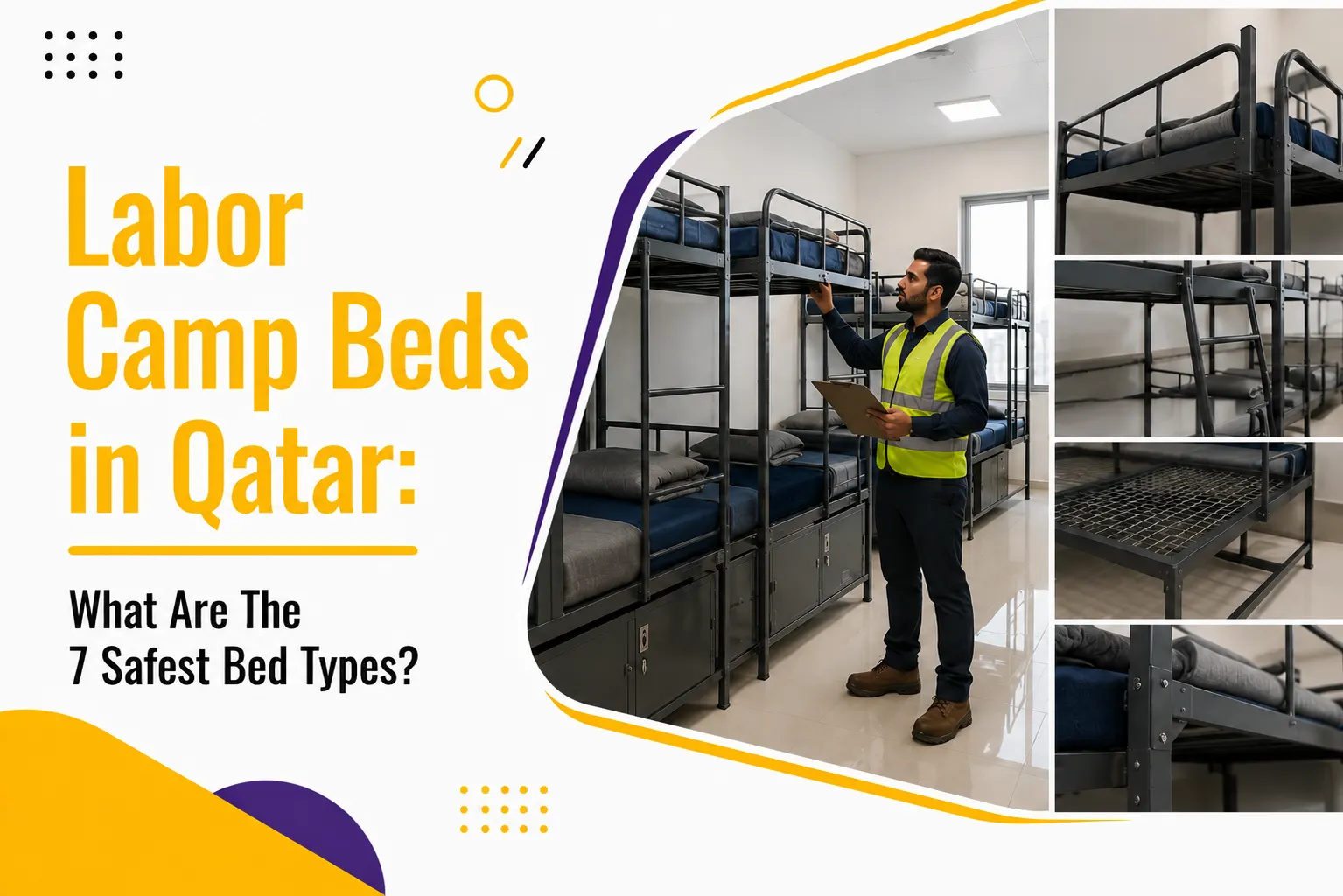
Walk through any large-scale labor camp in Qatar and you notice something immediately. The beds are not just furniture. They are infrastructure. They carry the weight of workers who clock 10-hour shifts in construction heat, manufacturing environments, and logistics operations. When a bed fails structurally, it does not just damage property. It creates a liability event, a safety incident, and in many cases, a compliance violation that can trigger regulatory scrutiny.
Qatar’s workforce housing has grown a lot in the last ten years. This is thanks to major infrastructure projects and growing industries. Worker accommodations need to follow certain rules set by the Ministry of Administrative Development, Labour and Social Affairs. These include guidelines on sleeping areas. So, picking labor camp beds in Qatar isn’t just about cost. It’s also about safety features, how much weight the beds can hold, and how well they’ll work in the long run.
This guide covers the seven safest beds for labor camps and staff accommodations. It explains each one’s strength, best uses, and what procurement teams need to know before ordering in bulk – keeping labor camps safer and more comfortable.
Why Structural Safety Is the Starting Point for Labor Camp Beds in Qatar
Most dorm furniture buys start with price, which makes sense. If you’re outfitting a camp for 500 or 2,000 workers, savings on each bed really add up. Still, seasoned accommodation managers in Qatar know cheap beds cause costly issues down the line.
Frame failure is the most common issue. Welded joints that were not properly finished, thin-gauge steel tubing that bends under repeated load stress, and ladder rungs that loosen over time are all failure points that surface within months of installation. In a labor camp environment, beds experience far more stress than residential furniture. Workers may be larger than average, shift patterns mean beds are used around the clock by rotating occupants, and the sheer volume of daily use accelerates wear.
There is also the vertical dimension to consider. Bunk beds, which dominate labor camp settings because they maximize floor space, create a specific risk profile. A top bunk failure does not just damage the bed. It puts someone at real physical risk. That is why structural ratings, weld quality, and material gauge are the non-negotiable starting points for any serious procurement conversation.
Load Ratings and What They Actually Mean
A load rating shows how much still weight a bed frame can handle safely. For single bunks in labor camps, the least rating needed is 200 kg. Heavy duty steel beds made for such settings usually manage between 250 kg and 300 kg each.
This is important because load ratings take into account the extra force when someone jumps down, rolls over, or climbs in and out. If a bed only needs to hold 200 kg still, it might break if the welds aren’t good or the frame design is off when more movement’s involved.
Material Gauge and Its Role in Long-Term Durability
Steel thickness is measured in gauge, and in the context of institutional bunk beds, thicker is safer. Most commercial-grade bunk beds use steel tubing in the 1.2mm to 2.0mm wall thickness range. Labor camp specifications should target a minimum of 1.5mm, with 2.0mm preferred for high-use environments.
Thicker steel resists deformation, maintains joint integrity longer, and significantly extends the usable life of the bed frame, which directly affects total cost of ownership over a three to five year replacement cycle.
The 7 Safest Bed Types for Labor Camp and Staff Accommodation Environments
1. Heavy-Duty Steel Bunk Beds with Full-Length Guardrails
This is the most widely used bed type across labor camps in Qatar, and for good reason. Heavy duty beds built with full-length guardrails on the top bunk address the single most common cause of sleeping injury in dormitory settings: rolloff during sleep. Full-length rails provide continuous protection regardless of how a worker positions themselves during sleep.
Key specifications include welded rail connections rather than bolt-on attachments, a frame constructed from square or rectangular steel tubing for greater resistance to lateral torque, and a slatted base that distributes mattress load evenly across the frame. For bulk bunk beds in Qatar, this configuration represents the strongest value proposition: proven safety record, straightforward maintenance, and wide parts availability.
2. Triple-Tier Steel Bunk Beds for High-Density Housing
Triple-tier bunk beds are increasingly common in Qatar’s high-density labor accommodation facilities where floor space is at a premium. Safe triple-tier designs use heavier gauge steel throughout, typically 2.0mm minimum, with additional cross-bracing at the mid-frame level.
Ladder access to the upper tiers should be integrated into the frame structure rather than attached as a separate component. Triple-tier beds in labor camps should ideally be wall-anchored or floor-anchored to prevent tipping.
3. Military-Grade Steel Beds with Bolt-Together Frames
Originally developed for barracks applications, military-grade bolt-together steel beds have found strong adoption in Qatar’s corporate dormitory furniture market.
The bolt-together design allows for complete disassembly and reassembly without compromising structural integrity, which is a significant advantage in labor camp environments where facilities are periodically reconfigured.
If a single rail or upright is damaged, it can be replaced without scrapping the entire frame, delivering meaningful cost savings for camp operators managing large inventories of staff accommodation beds in Doha and surrounding areas.
4. Powder-Coated Steel Bunk Beds with Anti-Corrosion Treatment
Qatar’s climate creates a specific durability challenge. The combination of high ambient humidity and salt-laden air near the Gulf coast accelerates corrosion in untreated steel frames. Powder-coated metal bunk beds in Doha with a proper anti-corrosion primer layer address this directly.
The powder coat provides a hard, impact-resistant surface that resists chipping far better than liquid paint, while the primer layer protects the base metal at weld points.
For labor camp beds in Qatar in coastal locations, this specification is a baseline requirement for any bed expected to perform reliably over a three to five year service life.
5. Folding Steel Bunk Beds for Flexible Accommodation Layouts
Some labor camp operators in Qatar manage facilities that serve variable workforce populations. Folding sturdy beds for workers provide a practical solution: they can be stored flat when not in use and redeployed quickly as numbers increase.
Safe folding bunk beds use heavy-duty steel hinges with positive locking mechanisms that engage automatically when deployed and require deliberate action to release. The locking system should be rated for the full load capacity of the bed and designed so it cannot accidentally disengage under normal use.
6. Fixed-Platform Steel Beds with Integrated Storage
In corporate dormitory furniture applications serving longer-term residents, fixed-platform steel beds with integrated under-bed storage offer a strong safety and functionality combination. The platform design eliminates a separate box spring, removing a potential failure point.
The frame sits lower to the ground, reducing fall risk, and integrated storage reduces floor clutter, a genuine safety consideration where clear emergency egress paths matter. Structural requirements remain unchanged: heavy-gauge steel, quality welds, and appropriate load ratings.
7. Modular Steel Bunk Systems with Configurable Layouts
Modular steel bunk systems use standardized components that can be assembled into single bunks, double bunks, L-shaped configurations, or room-spanning arrangements depending on facility layout. The safety advantage is that every component is engineered to work together, making structural performance predictable regardless of configuration.
For camp operators managing sturdy worker beds across multiple sites, modular systems reduce procurement complexity with consistent safety specifications throughout. They require more careful initial specification, but for large-scale operations the operational consistency is difficult to replicate with conventional fixed-design products.
Qatar-Specific Procurement Considerations for Bulk Bunk Beds
Sourcing bulk bunk beds in Qatar involves practical realities that differ from other markets. Import lead times, local assembly capacity, and compliance with Qatar’s worker accommodation standards all factor into the decision.
Qatar’s worker welfare framework includes provisions related to the physical quality of accommodation. Local suppliers who understand these requirements and can provide documentation of load ratings, material specifications, and compliance standards offer a meaningful advantage over purely price-competitive importers who cannot support the compliance documentation process.
What to Verify Before Placing a Bulk Order
- Request third-party load testing certificates, not just manufacturer claims
- Confirm steel gauge specifications in writing
- Ask for sample units before committing to large quantities
- Verify that replacement parts are available locally within a reasonable lead time
- Confirm the supplier can provide installation support for large orders
- Check that bed dimensions accommodate standard mattress sizes used in Qatar’s accommodation market
Common Mistakes That Undermine Safety in Labor Camp Bed Selection
The most common mistake is selecting beds based on catalog images rather than physical inspection. Photographs cannot convey weld quality, steel thickness, or frame rigidity under load.
Another frequent error is underspecifying mattress compatibility. Mattresses that are too thin provide insufficient support; mattresses that are too thick raise the sleeping surface above guardrail height on top bunks, negating fall protection.
Many procurement teams also overlook the installation phase. Even the best institutional steel beds become unsafe if assembled incorrectly. Torque specifications for bolted connections, proper leveling, and correct anchoring all matter. Supplier-provided installation support is worth factoring into the total cost comparison.
Choosing the Right Bed Type for Qatar’s Workforce Housing Realities
The seven bed types covered here represent a spectrum from the most widely used to the most operationally sophisticated. The right choice depends on the facility type, workforce population, density requirements, and compliance environment.
The one constant is that labor camp beds in Qatar have to meet institutional standards, not residential ones. Whether you’re new to procuring bulk bunk beds or an experienced hand checking your inventory, these specifications offer a solid guide. When you invest in sturdy worker beds from the start, you end up with less need for repairs, save on costs in the long run five years at least and you’re better prepared during audits.
Choose Safe & Durable Labor Camp Beds for Every Workforce
Provide workers with reliable, comfortable, and safety-focused labour camp beds designed for long-term performance in Qatar.
Frequently Asked Questions
What is the minimum load rating recommended for labor camp beds in Qatar?
For standard two-tier bunk beds used in labor camp environments, a minimum static load rating of 200 kg per bunk level is the baseline. Heavy duty steel beds rated at 250 kg or higher are preferable for high-use environments where beds are occupied around the clock by rotating shift workers. Always request third-party load testing documentation rather than relying on manufacturer-stated ratings.
How do metal bunk beds in Doha differ from standard residential bunk beds?
Institutional metal bunk beds in Doha used in labor camps and staff accommodation are built to substantially higher specifications than residential furniture. They use heavier gauge steel, industrial-grade welding, and load ratings that exceed residential standards by a significant margin. They are also designed for disassembly and reassembly, with more durable surface treatments typically powder-coated over anti-corrosion primers.
Are triple-tier bunk beds safe for labor camp use?
Triple-tier bunk beds can be safe when properly engineered and installed, but require more rigorous specification than standard two-tier units. Key requirements include heavier gauge steel, additional cross-bracing, positive-locking integrated ladders, and wall or floor anchoring to prevent tipping.
What surface treatment is most suitable for staff accommodation beds in Doha given Qatar's climate?
Powder coating over an anti-corrosion primer layer is the most appropriate surface treatment for staff accommodation beds in Doha. The Gulf climate combines high humidity, salt-laden air, and significant temperature variation all of which accelerate corrosion in untreated steel. Powder coating provides a harder, more chip-resistant surface than liquid paint, and the primer layer protects weld points where bare metal is most exposed.
How many beds can realistically be sourced locally versus imported for a large Qatar labor camp project?
For standard configurations, local sourcing is often feasible for orders of several hundred units with short lead times. Specialized configurations like modular systems or triple-tier units may require import lead times of six to twelve weeks. Engaging suppliers early is critical for large camp fitouts where delivery timing is tied to occupancy schedules.
What is the typical service life of heavy-duty steel beds in a labor camp environment?
Properly specified heavy duty steel beds, with appropriate surface treatment and correct installation, typically deliver a service life of five to seven years in labor camp environments. Under-specified beds often require replacement within two to three years. The total cost of ownership difference between a correctly specified bed and a cheaper alternative is frequently negative for the cheaper option over a five-year period.
Can bulk bunk bed orders in Qatar be customized for specific room dimensions?
Yes, many suppliers serving Qatar’s labor camp and corporate dormitory furniture market can accommodate dimensional customization for bulk orders. Common customizations include adjusting bed length, modifying guardrail height, and adapting frame footprint to non-standard room layouts. Customization typically requires minimum order quantities and longer lead times than standard configurations.