
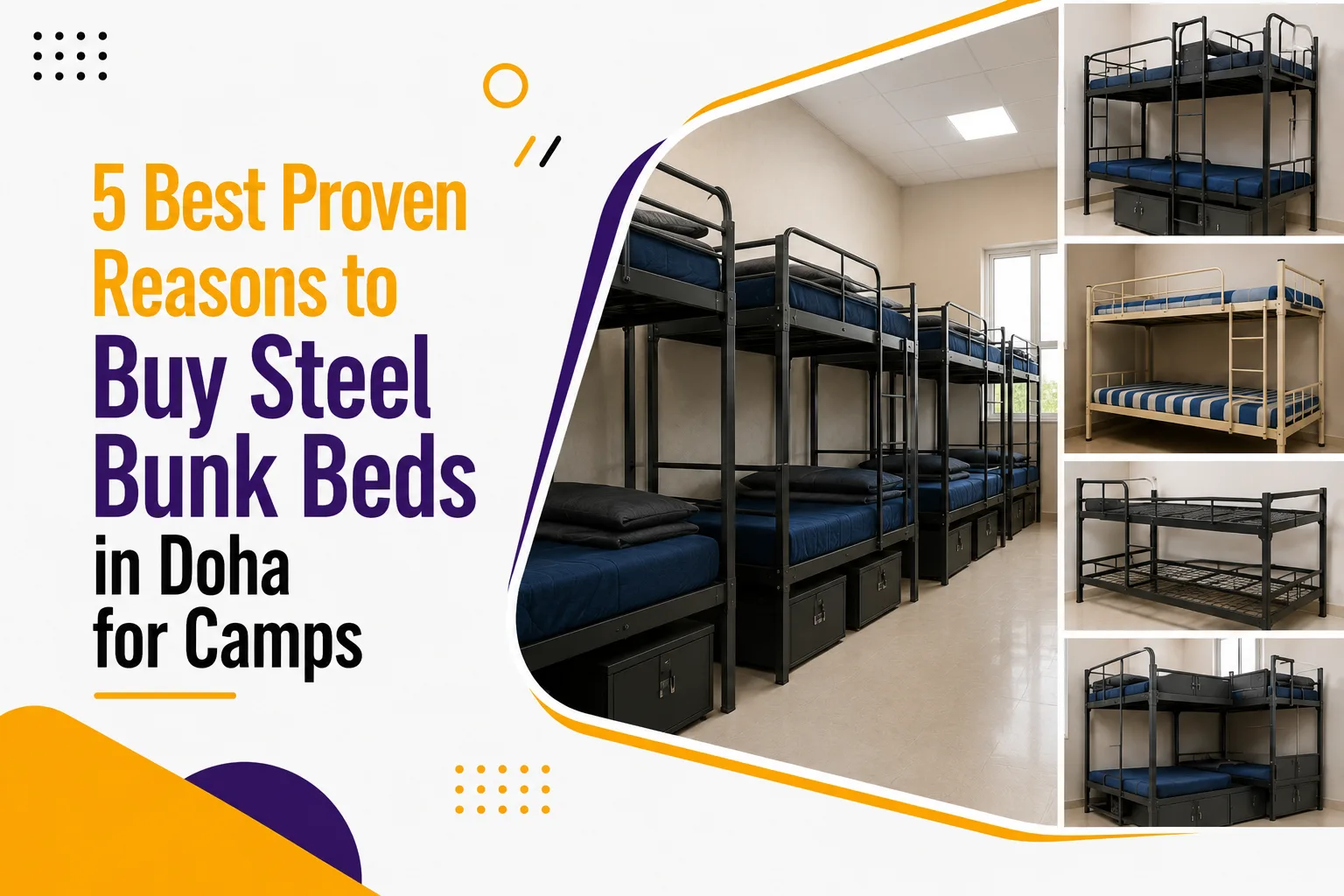
It is not the same as furnishing a typical home when it comes to staff housing or labour camps. You are not purchasing for a single individual or household. You are purchasing a bed for dozens or even hundreds of employees who require a bed that can withstand years of wear and tear, everyday use, and strict scheduling.
For this reason, a large number of camp managers and facility owners in Doha are moving away from wooden or inexpensive frames, which were never designed to meet this kind of demand, and toward steel bunk beds.
In addition to offering helpful purchasing advice to help you select the ideal configuration for your site, this guide explains the five main reasons steel bunk beds have emerged as the preferred option for labour camps, staff housing, and worker accommodations.
Why a Different Standard Is Needed for Camp Furniture
Tight budgets, strict deadlines, and frequent use are all factors in the operation of labour camps and staff housing. When shift workers sleep, sit, and keep their possessions on the same bed frame every day, a bed frame that functions properly in a private apartment frequently breaks down within months. This is the point at which typical furniture and actual labour camp furniture start to differ significantly.
Facility owners quickly learn that cheap frames mean repeat purchases, ongoing repairs, and unhappy residents. Heavy-duty sleeping setups solve this problem at the source by using materials and construction methods built for exactly this kind of continuous use.
5 Proven Reasons to Choose Steel Bunk Beds in Doha
1. Built to Handle Heavy Daily Use
Compared to a conventional bedroom, camp accommodations are significantly more worn. After working long shifts, employees need a bed that will not collapse, creak, or wobble after a few months. The heavy-gauge steel tubing used to make steel bunk beds in Doha is resistant to bending under repeated weight and movement.
- Welded seams with reinforcement as opposed to screws that eventually come loose
- Solid steel frames that support higher weight loads safely
- Sturdy ladder and rail systems that stay secure through years of climbing on and off
Steel is now the preferred material for commercial metal beds used in high-occupancy environments because of this kind of durability.
2. Extended Life Expectancy Lowers Long-Term Costs
Low-quality metal or timber frames may need to be replaced every two to three years in a busy camp. Conversely, steel bunk beds are designed to require no maintenance for at least ten years. This distinction can result in substantial savings for facility operators who manage dozens or hundreds of beds.
- Fewer replacement purchases over the life of the accommodation
- Reduced downtime from broken frames or unusable beds
- Lower total cost of ownership compared to cheaper alternatives that need constant repair
When you look at the total cost of furnishing a camp over five or ten years, steel bunk beds usually cost less than anything made from lighter materials.
3. Better Fire Safety and Structural Stability
Steel has a definite benefit when it comes to fire safety, which is a big concern in any public place. Unlike wood, steel does not ignite a fire or add combustible elements to an area already occupied by beds, mattresses, and personal belongings.
- Steel frames are unable to ignite fires or help them spread.
- Structural stability holds up even under stress or minor impact
- Many facility inspections and compliance checks favor metal frames for exactly this reason
For any camp manager thinking about staff accommodation supplies, fire performance should always be part of the decision, not an afterthought.
4. Improved cleanliness and simplicity of cleaning
Shared living spaces need furniture that encourages effective hygiene, especially in warm climates where dust, humidity, and bugs can easily become a problem. Steel bunk beds are considerably easier to clean than timber frames, which can hold odors, absorb moisture, and eventually provide cover for bugs.
- Smooth steel surfaces do not require any special chemicals and are easy to clean.
- No joints or wood grain where moisture and dust gather
- Resistant to termites and other pests that commonly damage hardwood furniture
This makes steel a practical choice not just for durability but also for maintaining a healthier living environment across the whole facility.
5. Space-Efficient Design for Higher Occupancy
A fixed floor area must frequently accommodate as many workers as feasible in labour camps. Steel bunk beds are made with this exact objective in mind, providing small footprints without compromising the safety or comfort of sleeping.
- Stackable two- or three-tier designs to maximize room capacity
- Built in ladder systems that do not take up extra floor space
- Optional storage attachments that reduce the need for separate furniture
The number of persons that may be safely and comfortably accommodated in any living space with a limited number of rooms is significantly increased by this effective, heavy-duty sleeping setup.
Should You Choose a Steel or Wooden Bunk Bed?
Camp management occasionally chooses hardwood bunk beds because they are initially less expensive, but when daily use over several years is considered, the comparison changes.
- Durability: Steel is resistant to bending and splitting, but wood can split or deteriorate under constant weight and moisture.
- Fire resistance: Steel does not ignite or spread fire like untreated wood does.
- Pest resistance: Steel is resistant to termites and wood-boring insects, which are common in humid storage and living spaces.
- Maintenance: Steel only needs periodic wiping and rust checks, whereas wood may need sanding, sealing, or repainting.
- Weight capacity: Steel frames often have a lesser chance of long-term structural failure and can withstand larger weight loads.
In a low-use setting, wood can be appropriate for a one-time purchase. For a labour camp running full occupancy every night of the year, steel is almost always the smarter long-term investment.
What to Look for in Furniture for Labour Camps
The quality of steel bunk beds varies greatly, and all of them are not constructed in the same manner. Examine this material thoroughly before making a significant purchase.
Frame Thickness and Material Grade
Inquire about the steel gauge used in the frame. Better resistance to bending and long-term wear is provided by thick steel tubing, which is crucial when various shift workers use the beds on a daily basis.
Weld Quality and Bolted Joints
Welded joints are frequently stronger and more durable than bolted connections, which can become loose with repeated movement over time. Unlike rusty screws, a well-welded frame keeps its shape and does not squeak.
Design of Ladders and Safety Rails
Strong protective rails and a dependable ladder or step system are required for upper bunks. This is particularly crucial in accommodations where residents require a simple, secure way to get in and out of bed since they are exhausted from lengthy shifts.
Finish and Coating
The frame is shielded from corrosion by a durable powder coat or anti-rust treatment, particularly in Doha’s typical coastal or humid environments. This detail can extend a bunk bed’s usable life by years.
Reliability of Suppliers
Particularly when servicing a large business, you need a provider who can deliver consistent quality across dozens or hundreds of units and provide support if something needs to be replaced or fixed later.
How Many Bunk Beds Are Required For Your Accommodations?
Accurately calculating the numbers before placing an order saves time and avoids costly reordering. A few doable actions facilitate planning:
- Measure available room space and factor in walking clearance around each bunk
- Confirm local occupancy regulations for shared worker accommodations
- Depending on the ceiling height, choose between two-tier and three-tier designs.
- Plan for storage needs alongside sleeping arrangements
- Order a small buffer beyond current headcount to allow for staff changes
Careful capacity planning helps facility managers avoid the usual error of underordering and needing to make a hurried, more expensive second order.
Maintenance Advice for Durable Steel Bunk Beds
A little routine maintenance helps even the strongest steel frame.
- Periodically clean frames to get rid of moisture and dust accumulation.
- Check welded joints and rails every few months for early signs of wear
- Tighten any adjustable fittings if the bed design includes them
- Touch up chipped paint or coating quickly to prevent rust from spreading
- To prolong their life, rotate the mattresses and let them air out.
Steel bunk beds stay in good working order for years with just a monthly inspection, so you can avoid unexpected repairs.
The Reasons Facility Managers Select Adonai Solutions
Furnishing a labour camp is rarely a one-item purchase. It usually involves bunk beds, mattresses, lockers, and general furniture supplied in bulk on a tight timeline. In addition to providing heavy-duty steel bunk beds, Adonai Solutions works closely with facility managers throughout Doha to provide a camp with various staff housing supplies, including lockers, mattresses, and cleaning agents.
Many camp operators would rather work with a single team that is familiar with bulk delivery schedules, camp compliance requirements, and the day-to-day realities of managing shared worker housing than piecing together orders from many suppliers.
Final Thoughts
A labour camp’s furnishings are a long-term investment rather than a one-time purchase that can be made incorrectly. Steel bunk beds in Doha offer the longevity, security, and space efficiency that camp accommodations actually require without the frequent upkeep and repairs required by less expensive options.
Selecting the appropriate heavy-duty sleeping setup today will save time, money, and hassle for years to come, whether you are constructing a new facility or renovating an old one.
Ready to Furnish Your Camp?
If you are searching for steel bunk beds near you and want a supplier who can handle bulk orders reliably, Adonai Solutions is ready to help. Get a quote tailored to your accommodation size and headcount.
Frequently Asked Questions
Do steel bunk beds cost more than wooden ones?
Steel bunk beds may cost a little more initially than simple wooden ones, but over time, steel is usually more cost-effective. Steel frames can last up to ten years with minimal maintenance, but wooden frames in high-use camp environments typically wear out more quickly and need to be replaced every two to three years. Steel bunk beds are usually the more economical choice for large accommodations when the entire cost over several years, including replacement and repair costs, are taken into account.
What is the maximum weight that camp bunk beds could support?
A high-quality steel bunk bed for camp use should be able to comfortably sustain at least 150 kg per sleeping level, though the figure varies on the steel gauge and frame design. Before placing a bulk order, it is worthwhile to verify the manufacturer’s tested weight rating because these beds are used by various residents on a regular basis for extended periods of time. This is in contrast to thinking that all steel frames have the same strength.
How long do steel bunk beds typically last in a labour camp?
With proper care, high-quality steel bunk beds can last up to ten years in a busy camp. Frame thickness, weld quality, and frequency of maintenance all affect longevity. Compared to camps that neglect routine maintenance, camps that adhere to a basic maintenance schedule by checking joints and touching up coating as necessary tend to get a lot more use out of their furniture.
Is it possible to customize steel bunk beds to fit various room sizes?
In fact, most manufacturers provide various layouts, including two- and three-tier designs, different widths, and optional storage attachments. This flexibility makes it easier to fit bunk beds in rooms with different ceiling heights and floor designs, which is especially useful when equipping multiple rooms of different sizes within the same accommodation.
Do steel bunk beds require more maintenance than other furniture types?
In actuality, steel bunk beds need less maintenance than their wooden counterparts. Basic maintenance includes cleaning frames to remove dust, checking welded connections on a regular basis, and repairing any chipped coating to prevent corrosion. For busy facility managers, steel is a more sensible option because it does not have to be sealed, sanded, or otherwise maintained like hardwood furniture often does.
Where in Doha can I get reliable steel bunk beds?
Since camp-grade beds are subject to distinct durability and safety criteria, look for suppliers who specialize in commercial metal beds and labour camp furniture rather than regular home furniture merchants. Inquire about the thickness of the frame, the quality of the weld, and whether the supplier can manage large orders with uniform quality in each unit. It is a strong indication that suppliers with experience in staff accommodation supplies are aware of the unique requirements of camp furnishings because they will typically inquire in-depth about your headcount and room layout.