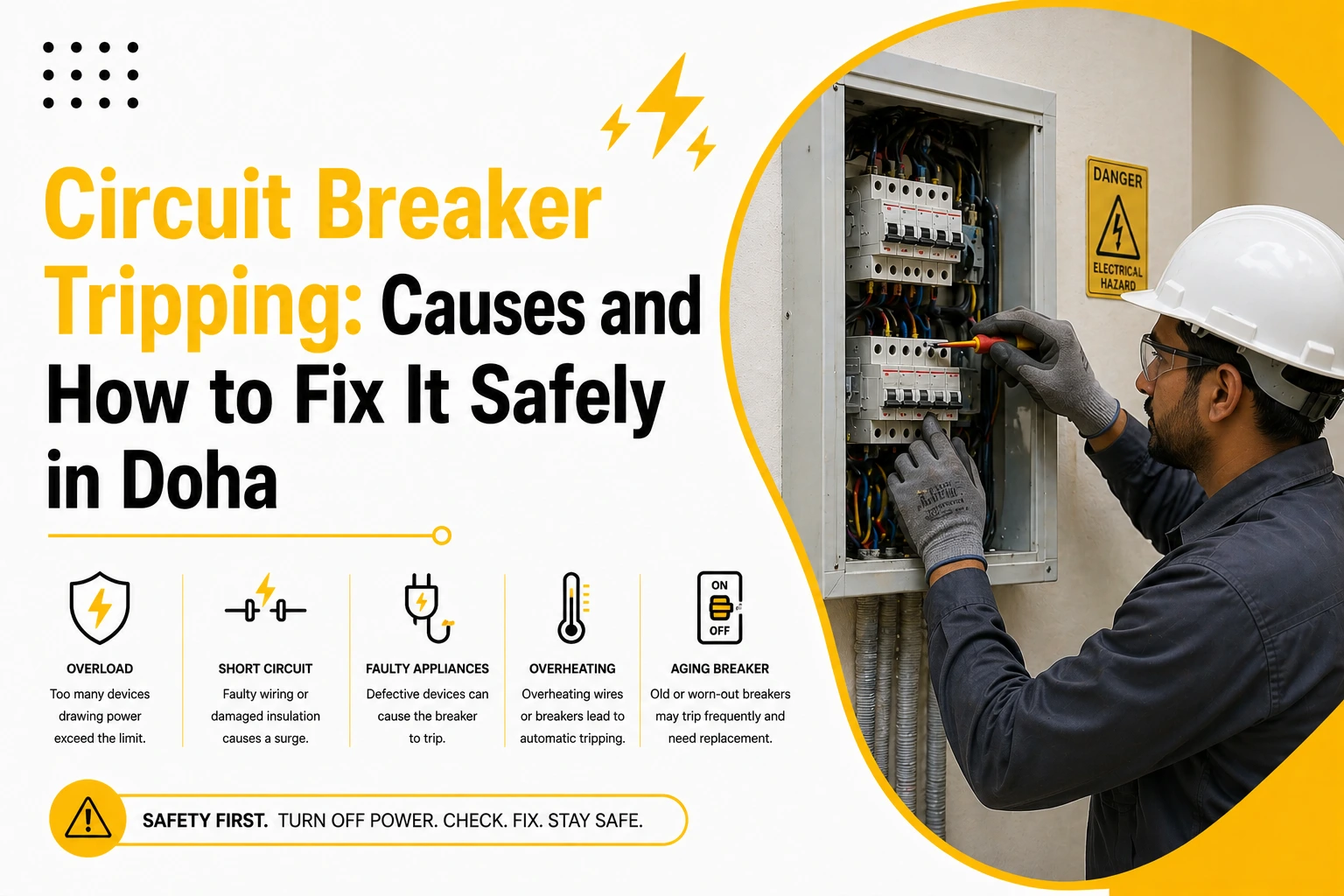
In Doha’s intense desert climate, your home’s electrical system is the silent engine behind your comfort. It works overtime to keep your AC running during 45°C heatwaves, but this pressure often leads to a sudden blackout. When the lights flicker out, it is usually due to a circuit breaker tripping, a critical safety response designed to prevent catastrophic house fires.
Figuring out why your power keeps dying is the first step in keeping your home safe. In Qatar’s intense heat and humidity, electrical glitches aren’t just annoying; they’re dangerous. This guide cuts through the noise to show you exactly why your breakers are failing and how to protect your family from a real disaster.
What Is Circuit Breaker Tripping and Why Does It Happen?
A circuit breaker is an automatic switch protecting wiring from excess current. When flow reaches dangerous levels, it flips to the “off” position to prevent heat damage.
Circuit breaker tripping is a vital safety feature. Without it, wires could melt their insulation and ignite house fires. It mitigates fire risks and protects expensive appliances from surges. This prevents temporary issues from becoming permanent catastrophes in modern households.
Several factors trigger this response in Doha homes. Identifying the root cause is essential for long-term maintenance.
-
- Circuit Overload: Too many high-wattage devices on one circuit.
-
- Short Circuits: Hot wire touching a neutral wire.
-
- Ground Faults: Electricity escaping to the ground.
-
- Faulty Appliances: Damaged devices drawing inconsistent power.
-
- Environment: Humidity or moisture entering the DB box.
Overload vs. Short Circuit : What’s the Difference?
Distinguishing these is critical for electrical troubleshooting. An overload occurs when electrical demand exceeds the breaker’s rated capacity. Running multiple high-draw appliances simultaneously will trip the breaker. Overloads are generally predictable based on usage habits.
A short circuit is a more serious fault. It happens when wires make direct contact, creating a path of least resistance. This surge generates intense heat instantly, forcing an immediate trip. Short circuits usually indicate physical wiring damage or device failure.
Short circuits require professional attention to clear the fault safely. Communicate these details to an expert to speed up the repair process.
Signs of a Circuit Overload:
-
- Flickering or dimming lights during appliance use.
- Warm outlets or switch covers.
-
- Buzzing sounds from the wall or DB box.
-
- Frequent but not immediate tripping.
See Also: Transform your interior office aesthetics quickly and affordably with our highly resilient vinyl carpets in Qatar.
Detailed Common Causes in Doha Homes
Living in Qatar presents specific environmental challenges that stress local electrical grids. Here is a deeper look at why circuit breaker tripping occurs so frequently in local villas and apartments:
1. The “AC Over-Sync” Phenomenon
In Doha, air conditioning isn’t a luxury; it’s a survival tool. Most homes have multiple split or central units. If several compressors kick in at the exact same moment, the combined “inrush current” can momentarily exceed your breaker’s limit. This is especially common during the peak afternoon heat.
2. High Salinity and Coastal Corrosion
If you live in West Bay, Lusail, or near the Corniche, the salt-heavy air is your system’s enemy. Salt facilitates rapid oxidation on copper wiring terminals. Corroded connections create high resistance, which generates heat. This heat can trick a thermal-magnetic breaker into tripping even if the actual amperage load is normal.
3. Dust and Sand Accumulation
Doha’s frequent dust storms don’t just affect your windows. Fine particulate matter can settle inside outdoor DB boxes or socket housings. Over time, this dust can absorb moisture from the air, becoming semi-conductive. This creates “tracking” paths for electricity, leading to mystery ground faults and frequent power cuts.
4. Aging Infrastructure in Historic Districts
In older parts of Doha like Najma or Mushaireb, many buildings were wired decades ago. These systems were designed for a few lights and a fridge;not for high-speed gaming rigs, smart home hubs, and powerful espresso machines. These outdated wires simply cannot handle 2026 power demands.
Ground Fault : The Third Culprit
A ground fault occurs when a hot wire touches a grounded surface. This creates an electrocution hazard as electricity seeks a path to the earth. In Doha, moisture in bathrooms and kitchens often causes these faults. Water acts as a conductor, bridging gaps in old or damaged wiring.
Modern Doha homes use GFCIs or RCDs for DB box safety. These devices detect tiny current leaks to prevent shocks. If appliances cause frequent power cuts in wet areas, a ground fault is likely. Corroded water heater elements are common culprits.
Read Also:
- Bed Bug Heat Treatment: Is It Better Than Chemical Sprays?
- AC Deep Cleaning in Qatar: 7 Proven Health Benefits
- Fragile Item Packing: How to Protect Valuables When Moving in Doha
Is It a Power Cut or Circuit Breaker Tripping?
Knowing how to fix power cut (1) issues starts with identifying the source. Check if neighbouring streetlights and homes are dark. If the neighbourhood is dark, it is a utility outage. You must wait for authorities to restore the service.
If only your home is dark, the issue is internal. Go to your DB box to check the switch positions. Checking the DB box is fundamental to electrical troubleshooting. A quick glance can resolve the issue in seconds.
How to distinguish:
-
- Power Cut: The neighbourhood is dark; the main breaker is “on.”
-
- Tripped Breaker: Only your home is dark; a specific switch is “off.”
What Your DB Box Is Telling You
The DB box is your home’s electrical nerve center. Maintaining DB box safety requires understanding the internal panel labels. Each switch corresponds to specific rooms like the kitchen or master bedroom. This allows you to isolate faults to a single area.
In a circuit breaker tripping event, the switch moves to a middle or “off” position. Indicators often turn red or orange. Flipping the switch back restores power if the fault is cleared. Always investigate why it tripped before resetting.
Discolouration or heat from the panel indicates arcing. These are high-risk fire hazards requiring immediate professional intervention.
High-Load Appliances as Suspects
In troubleshooting, focus on appliances that generate heat or use large motors. These are the “heavy hitters” of your grid. In Doha, the AC is the main suspect. Malfunctioning compressors pull excessive amperage, tripping the breaker immediately.
Washing machines and water heaters are also likely causes. If tripping happens during specific cycles, the internal motor or element is failing. These tripping incidents peak when systems are pushed to their limits.
How to Safely Reset Your DB Box
Resetting requires caution to ensure safety. Only attempt this after unplugging the suspect appliance. Repeated resets without fixing the cause can damage home wiring. This leads to expensive rewiring projects later.
Safe Reset Process:
-
- Unplug everything on the affected circuit.
-
- Locate the breaker in the “off” or “neutral” position.
-
- Flip to “Off” first to reset the internal spring.
-
- Flip to “On” to restore electricity.
When Tripping Becomes a Serious Warning
A single trip might be a fluke, but repeated circuit breaker tripping is a major warning sign. It indicates deep infrastructure issues. Ignoring frequent trips creates a fire hazard. Watch for burning smells, sparks, or scorched outlets.
Ignoring these signs leads to a fixed power cut situation requiring charred-wire replacement. This is far more costly than a simple breaker swap.
Professional Solutions and Efficiency
Licensed technicians perform load calculations to prevent tripping. They redistribute power across underutilised circuits for balance. Thermal imaging identifies hot spots inside walls before they ignite. This detects loose connections invisible to the eye.
Energy efficiency reduces the frequency of circuit breaker tripping. High-efficiency ACs and LEDs reduce the base load. Clean AC filters also prevent motor overworking. A clean system runs cooler and is less likely to surge your DB box.
Outdoor Faults and Voltage Stability
Outdoor lighting and pool pumps are susceptible to moisture and heat. These often cause circuit breaker tripping. Dust in outdoor sockets creates high-resistance connections. This generates heat and causes shorts that kill house power.
Voltage stabilizers protect electronics from grid fluctuations. This is useful in older neighbourhoods with heavy grid strain. Unstable voltage triggers tripping in high-draw appliances. Stabilisers act as a buffer for your home.
Advanced Diagnostic Strategies for Doha Residents
While a quick reset might fix a one-off glitch, if your breakers keep popping in Qatar’s salty coastal air, you’ve got a deeper problem on your hands. A massive, yet totally ignored, culprit is something called harmonic distortion. It’s caused by the very tech we rely on every day, like LED lights and computer power setups.
In crowded parts of Doha, these harmonics can actually cause your neutral wires to cook from the inside out. The scary part? This happens even if your breaker hasn’t hit its official limit yet. It’s an invisible strain that puts your home at risk when you least expect it.
Furthermore, consider the impact of the Power Factor on your stability. Inductive loads, like older AC compressors, can cause a lag in current. This inefficiency doesn’t just increase your Kahramaa bill; it puts strain on the electromagnetic trip mechanism within your DB box.
Finally, ensure your maintenance provider performs an earth loop impedance test. This check ensures that in a major fault, the path to the ground is efficient enough to trigger the breaker instantly. If the impedance is too high, the breaker won’t trip fast enough to prevent a fire.
Why Use Licensed Electricians?
Licensed pros ensure your home meets Kahramaa standards. This keeps both the national grid and your home safe. They use certified parts designed for the Middle East’s high temperatures. Uncertified “handymen” create fire risks that insurance will not cover.
Licensed technicians handle high-voltage systems safely. They prevent dangerous bypasses of essential safety features.
How Adonai Solutions Helps
Adonai Solutions provides expert facility management and electrical services in Doha. Our licensed team keeps your systems running smoothly. Power failures are cooling emergencies in Qatar. We offer everything from inspections to complex fault rewiring.
Trust Adonai Solutions for expert troubleshooting and peace of mind. Contact us to secure your home’s electrical health.
Conclusion
Your home’s circuit breaker tripping is how it communicates with you. It’s also a critical safety feature that separates a common power interruption from a catastrophic electrical fire. Knowing the difference between an overload or short circuit, you can take control of your home’s safety.
Stop letting minor electrical hiccups snowball into a total cooling crisis during the brutal Qatari summer. If you’re seeing persistent glitches, it’s a loud and clear warning that your home’s infrastructure is crying out for a professional upgrade. Whether you need to balance your electrical load or swap out dangerous, outdated wiring, being proactive today is going to save you a massive headache and a lot of money down the road.
Choosing the expert team at Adonai Solutions means your home stays the safe, cool, and stress-free sanctuary it’s meant to be. Why wait for the next frustrating power cut to realise your electrical health is failing? Take charge of your property now. Safeguard your space today so you can finally kick back and enjoy the pure peace of mind that only a resilient, modern electrical system provides.
Stop Circuit Breaker Tripping Before It Becomes a Major Electrical Problem
Protect your property from outages and electrical hazards. Contact our certified electricians for fast diagnosis, reliable repairs, and long-term solutions in Doha.
Frequently Asked Questions
What causes a circuit breaker to trip?
A circuit breaker tripping is a safety mechanism designed to protect your home from electrical fires. The most frequent cause is an overloaded circuit, which happens when too many high-power appliances run simultaneously. Other common triggers include short circuits, where a hot wire touches a neutral wire, or ground faults caused by moisture. If you experience persistent issues, Adonai Solutions provides comprehensive electrical inspections to identify and resolve these underlying wiring faults quickly.
When should I call a professional for circuit breaker issues?
You should contact a technician if a breaker trips immediately after being reset or if you notice a burning smell near the panel. These symptoms often indicate serious internal damage or a failing component. Handling live wires without expertise is dangerous; therefore, professional electrical troubleshooting is required for any recurring faults. The certified team at Adonai Solutions can safely replace faulty breakers and upgrade outdated distribution boards to meet modern safety standards and local regulations.
Is a circuit breaker tripping the same as a general power cut?
No, these are different issues. A general power cut usually affects your entire street or neighborhood due to grid maintenance or external faults. However, if your neighbors have electricity while your home is dark, you likely need to fix power cut issues within your own premises. This typically involves checking your distribution board to see if a specific switch has flipped down, which indicates a localized problem rather than a utility provider outage.
Can humidity or heat in Qatar affect my electrical system?
Qatar’s extreme environmental conditions significantly affect electrical performance. Intense summer heat forces air conditioning units to work harder, which can overload the circuit breaker and cause it to trip during peak hours. Furthermore, high humidity can cause moisture buildup in outdoor sockets or AC isolators, leading to “nuisance tripping.” Ensuring that all external electrical points are properly weatherproofed is essential for maintaining a stable and safe power supply throughout the humid summer months.
How can I prevent my circuit breaker from tripping?
To minimize disruptions, avoid plugging multiple heavy-duty devices into a single outlet or power strip. Distributing the electrical load across different circuits helps maintain DB box safety and prevents overheating. Regularly checking your appliance cords for fraying and ensuring your AC units are serviced can also reduce strain. For residents in Doha, Adonai Solutions offers preventative maintenance packages that ensure your domestic electrical system is balanced and capable of handling seasonal power demands.
What should I check in my DB box for safety?
For optimal DB box safety, conduct a visual inspection once a month. Look for any discoloration, soot marks, or melting plastic around the switches, as these are signs of dangerous arcing. Ensure the area around the panel is clear of clutter and that the cabinet is kept dry.