
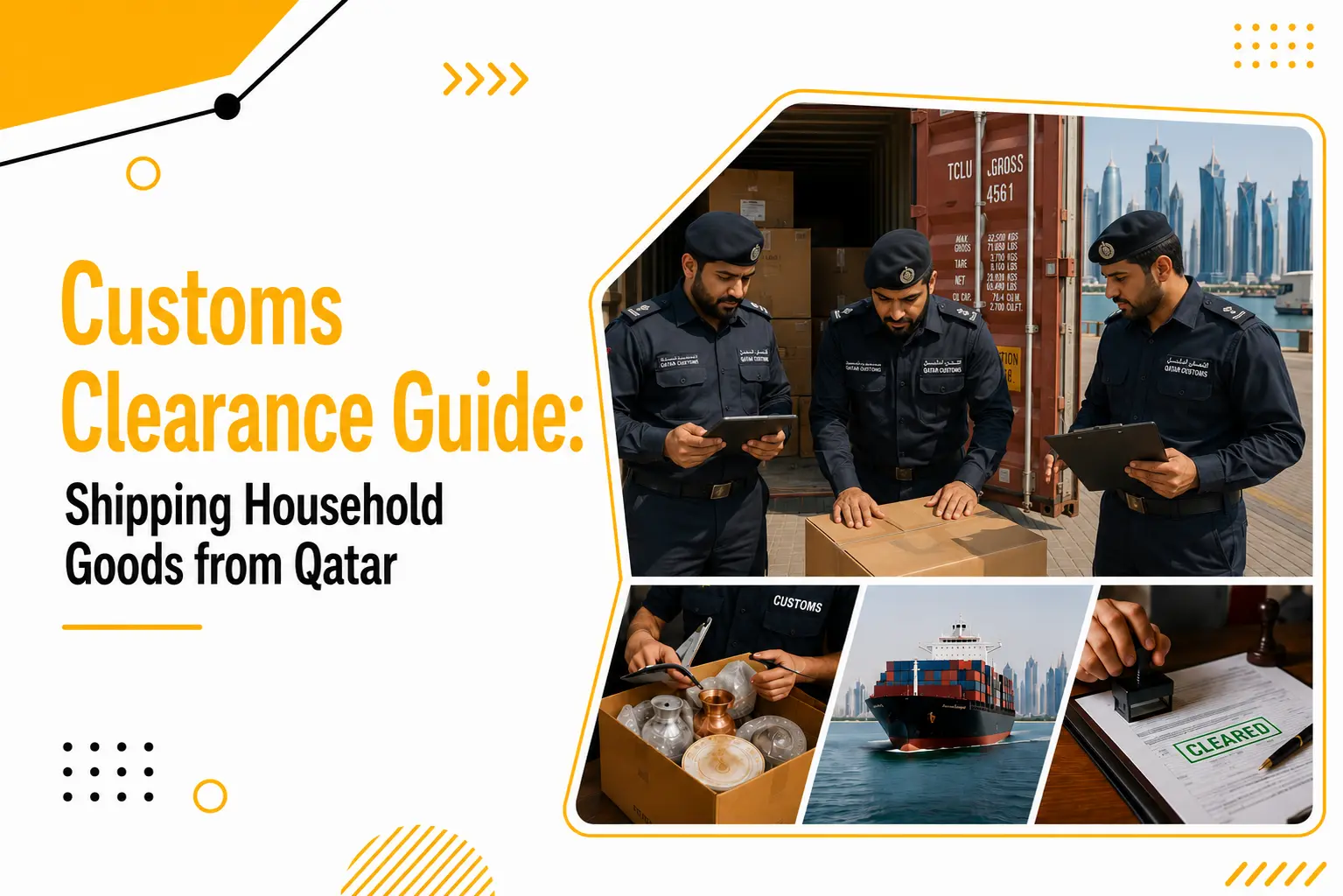
Relocating from the Arabian Gulf is a massive life transition that requires more than just packing boxes.It is not only about putting all your stuff in boxes but moving all furniture, appliances, and belongings over oceans. For most residents in Doha, the challenge lies in balancing the emotional aspect of leaving with the mechanical necessity of port logistics.
“Did you know that approximately 200,000 expats relocate from Qatar annually, making the demand for a reliable customs clearance guide higher than ever?” This high turnover rate means that thousands are navigating the same hurdles at Hamad Port simultaneously. This leads to high competition for shipping containers and clearing agents during peak summer months.
The purpose here is not only to make the seemingly complicated international shipping rules more straightforward but also to ensure your cargo documentation is impeccable. These simple steps will prevent financial penalties at the border and ensure a smooth transit.
Leaving the Country? A Customs Clearance Guide for Expats
Navigating the Qatar Customs Exit Strategy
To depart Qatar successfully, you must engage with the General Authority of Customs. This agency monitors every item leaving the country to ensure national treasures and restricted goods stay within the borders. Every expat needs a customs clearance guide because the “Al Nadeeb” digital system used for declarations is typically only accessible to licensed agents.
You cannot simply show up at the port with a trailer. The exit strategy involves a formal declaration of “used personal effects” to the authorities. This status is vital because it separates your household move from commercial trade activities. Commercial trade would otherwise attract high export duties and different regulatory scrutiny from the government.
Professional agents act as the bridge between your home and the shipping vessel. They ensure that all local port fees are paid before the container is loaded. This coordination is essential for a stress-free transition out of the Doha metropolitan area.
See Also: Need reliable power distribution for your facility? Discover our premium extension cords in Qatar to protect against voltage spikes.
Understanding International Shipping Rules
There are global standards for international shipping that dictate how goods flow across different regions of the world. This includes all aspects of shipping, including but not limited to the type of pallets that can be used and how batteries are to be isolated.
If you do not comply with these regulations globally, your shipment may not be accepted in the final destination.
Different modes of transport carry different legal burdens for the owner. Sea freight is ideal for full households due to its volume, but it is subject to specific maritime laws. Air cargo follows much stricter security protocols under international shipping guidelines, specifically regarding liquids and pressurized containers.
These rules also dictate how you must handle “dual-use” items that could have military applications. Many high-end drones or specialized radio equipment fall into this category. You must verify these details before the packing crew arrives at your residence.
Compliance and Coordination
Maintaining compliance means satisfying two masters: the laws of Qatar and the laws of your destination. This requires a high level of coordination between your moving crew in Doha and your receiving agent abroad. A good customs clearance guide emphasizes that your paperwork must be mirrored at both ends of the journey.
Coordination also involves timing your arrival with the arrival of the vessel. You must ensure your goods don’t arrive at the destination before you have the legal right to claim them. If the goods arrive too early, they may be sent back or destroyed at your expense.
Communication is the primary tool for successful coordination during this phase. You should have a dedicated point of contact at the logistics company. This person will manage the timeline and update you on any changes in port status.
Read Also:
- Unclogging Drains in Qatar: Mechanical Snakes vs Chemical Cleaners
- Hot Water Extraction: The Best Method for Removing Stains
- Workplace Hygiene Standards: Reducing Sick Days in the Office
Essential Cargo Documentation: The Paperwork Trail
Documentation is the “passport” for your belongings. Even a minor typo in a serial number or a name can flag your container for a “red channel” inspection. Accurate documentation is the only way to avoid the crushing costs of port delays and manual inspections.
Required Documents for Shipping from Qatar
To clear the Qatari exit gates, you must provide a specific dossier of documentation. These documents are the primary tools used by officers to evaluate the risk and value of your shipment:
-
- Packing List (Detailed and itemized): Every box must have a unique number. Instead of “Kitchen items,” write “Used cookware and stainless steel utensils.” This level of detail is a core requirement in any customs clearance guide.
-
- Copy of Passport and Qatar ID (QID): These verify your identity and legal residency in Qatar. Keep high-resolution scans available digitally at all times.
-
- Original Bill of Lading: This is the legal title to your goods. It proves that you own the contents of the container and have a contract with the shipping line.
-
- Authorization Letter for the Clearing Agent: A signed document that empowers a professional agent to act as your legal representative.
Handling Special Cargo Documentation
If you are moving high-value art, luxury watches, or rare musical instruments, the standard forms are insufficient. You may need secondary permits or “Certificates of Origin” to prove the items were not recently purchased. This specialized documentation is essential for avoiding heavy import taxes in your next destination.
Attestations from the Ministry of Foreign Affairs may be required for certain sensitive documents. This process adds an extra layer of verification to your file. Always start this process at least four weeks before your scheduled departure date.
Secondary permits for vehicles or boats follow a completely different set of rules. These require proof of ownership and a clear title from the traffic department. Ensure these are included in your master folder to prevent port rejection.
Prohibited and Restricted Items
What You Can and Cannot Ship
Any functional customs clearance guide must address the “forbidden” list. Attempting to ship prohibited items is not just a logistical error; it is a legal violation. Modern scanning technology makes it nearly impossible to hide restricted goods inside a shipping container today.
Prohibited Items in International Shipping
The following items are strictly banned and should never be packed in your household shipment:
-
- Alcohol and Narcotics: Qatar is a zero-tolerance jurisdiction. Shipping any quantity of alcohol is strictly forbidden and can result in immediate seizure of the container.
-
- Pork Products: These are not permitted for export in personal shipments under local religious and cultural laws.
-
- Inflammable Materials or Aerosols: This includes hairspray, spray paint, cleaning fluids, and gas canisters. These are seen as fire hazards on long sea voyages across the ocean.
-
- Religious or Political Materials Deemed Offensive: Anything that contradicts the values of the State of Qatar or the destination country can be confiscated.
Restricted Items Requiring Special Permits
Some items are allowed only if you have the right “hall pass” from the government. Your customs clearance guide should note that these require pre-approval from government ministries:
-
- Cultural Artifacts and High-Value Antiques: These often require clearance from the Qatar Museums Authority. This proves they are not national heritage items belonging to the state.
-
- Prescription Medications and Chemicals: Large supplies of medicine require a doctor’s note and Ministry of Health approval. These must be clearly listed in your documentation to avoid issues.
Step-by-Step Process for a Smooth Clearance
Following the Customs Clearance Guide Step-by-Step
The logistics of a move should be treated like a project with clear milestones. Following a structured clearance guide prevents the panic of last-minute packing and missing signatures.
The Pre-Move Survey
A professional should visit your home to calculate the cubic volume of your belongings. This step is vital because it determines if you need a 20ft or 40ft container. It also allows the expert to flag items that might violate international shipping guidelines.
Inventory and Packing
As boxes are sealed, the itemized list is created for the authorities. Using high-quality packing materials is non-negotiable for international transit. If a box breaks during a customs inspection, the port authorities will not repack it for you.
The Inspection Process
Your goods are trucked to the Doha Cargo Terminal or Hamad Port for processing. Here, they pass through a massive X-ray scanner for security. If the documentation matches the X-ray, the container is sealed with a “Customs Bolt” and loaded.
Avoiding Common Pitfalls and Delays
Why You Need a Customs Clearance Guide to Avoid Fees
Relocation costs can skyrocket if you don’t account for port storage fees. When documentation is incomplete, the shipping line will charge you “Demurrage” and “Detention” fees. These charges accumulate daily and can quickly reach thousands of dollars in total.
Organization is the best way to avoid these unnecessary fees. Label every box on at least two sides with its corresponding number from the list. This allows inspectors to find specific items quickly without tearing through your entire shipment.
Avoid packing “hidden” items within your furniture drawers. Customs officers specifically look for this behavior during physical inspections. Such actions can lead to your entire shipment being flagged for a deep manual search.
Partnering for Success: Adonai Solutions
Professional Support with Adonai Solutions
Adonai Solutions is a recognized leader in Qatar’s logistics and relocation landscape. They provide more than just transport; they provide a comprehensive shield against technicalities. Their team is deeply familiar with the nuances of Doha’s bureaucracy and global standards.
Their expertise simplifies the most complex international rules for shipping. They turn a mountain of paperwork into a manageable and streamlined process. By managing your customs clearance guide requirements from start to finish, they ensure your effects are handled professionally.
They also provide expert packing services that meet international standards. This reduces the risk of damage during the long sea voyage. Their commitment to customer satisfaction makes them a top choice for departing expats.
Conclusion
Leaving Qatar is leaving behind a chapter in your life; however, it shouldn’t stress you. You can manage the variables if you follow a customs clearance guide that will make things much easier for you. The secret to success lies in the accuracy of your cargo documentation and strict adherence to rules.
When you prioritise organisation, you gain the peace of mind needed for a new home. Ensure your paperwork is ready and your prohibited items are removed. A smooth exit from Qatar is the first step toward a successful new beginning.
Professional assistance will always provide a safer path through the bureaucracy. Do not leave your life’s belongings to chance or unverified agents. Your future in your new destination depends on the work you do today at the port.
The global shipping industry is constantly changing its internal protocols. Stay informed by checking for updates to international shipping rules regularly. This proactive approach will serve you well as you navigate the international waters.
Simplify International Moving from Qatar
Get expert customs clearance and household shipping solutions for safe, stress-free international relocation.
Frequently Asked Questions
What are the steps for customs clearance?
The process begins with the preparation of an itemized packing list and a formal declaration through the Al Nadeeb system. Once the cargo arrives at Port, authorities conduct a risk assessment and X-ray scanning to verify the contents. If everything matches the provided cargo documentation, the shipment is released. Partnering with Adonai Solutions ensures each step is handled professionally, preventing the common filing errors that lead to unnecessary inspections and delays.
How long does customs clearance take?
Typically, air freight clearance in Qatar takes 3 to 5 business days, while sea freight usually spans 7 to 10 days. These timelines depend heavily on port congestion and the accuracy of your customs clearance guide instructions. To expedite this timeframe, Adonai Solutions leverages their local expertise to coordinate directly with port officials. Their proactive approach minimizes the time your household goods spend sitting in the terminal awaiting final approval and release.
What items are prohibited from international shipping?
Strict international shipping rules prohibit the movement of hazardous materials, narcotics, and alcohol. In Qatar, this list extends to pork products and any media deemed culturally offensive or politically sensitive. Shipping these items can lead to the immediate seizure of your entire container. Adonai Solutions provides a detailed pre-move survey to identify these restricted goods early, ensuring your shipment remains fully compliant with both Qatari exit laws and global transit regulations.
What documents are required for customs clearance in Qatar?
Standard cargo documentation for expats includes a detailed packing list, a clear copy of your Passport and Qatar ID, and the Original Bill of Lading. You must also provide a signed Authorization Letter that allows your clearing agent to represent you before the General Authority of Customs. Accuracy is vital here; even a minor typo in your QID number can cause the authorities to flag your shipment for a manual, time-consuming terminal inspection.
What is the "Al Nadeeb" system and do I need to register?
Al Nadeeb is Qatar’s “one-stop-shop” electronic system for all customs procedures, designed to digitize the customs clearance guide process. While individual expats don’t usually register personally, your clearing agent must use this portal to submit declarations and pay duties. The system links various government agencies, allowing for faster approvals. Ensuring your agent is properly registered in Al Nadeeb is the most critical step for a legally compliant move out of Doha.
What is the penalty for including prohibited items in international shipping?
Attempting to bypass international shipping rules by including banned items can result in heavy financial fines, the permanent confiscation of goods, and potential criminal prosecution. For expats, this might also lead to a blacklisting in the Qatar Customs system, making future relocations difficult. Beyond legal fees, you will face massive storage costs as your shipment is held for investigation. It is never worth the risk to hide restricted items in your cargo.