
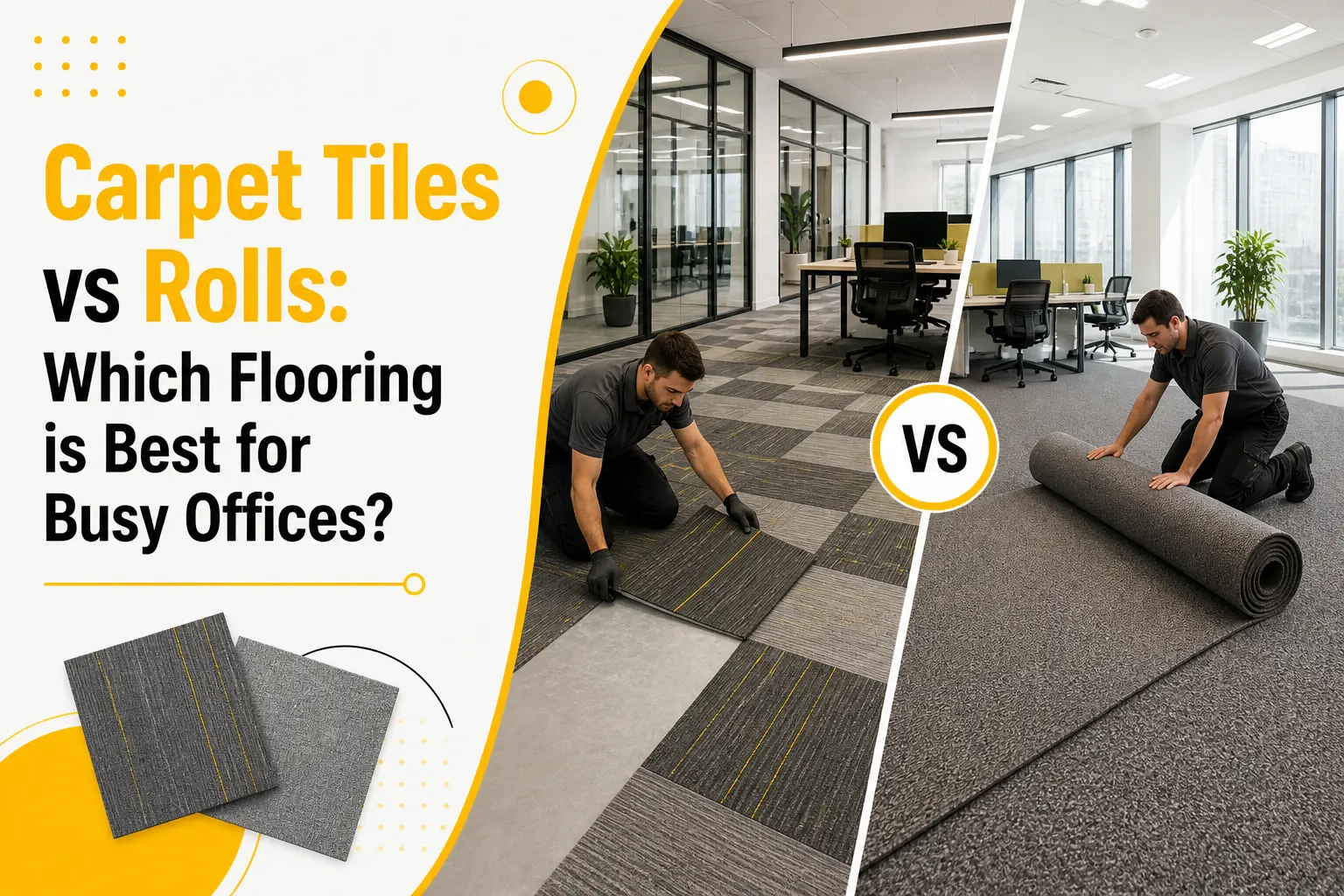
Selecting the best floor for a busy Qatar office isn’t just about looks; it’s a practical move to make sure your workspace actually lasts. When you look at carpet tiles vs rolls, the choice really centers on how much time and money you can spare for cleaning and repairs.
Businesses across Doha are ditching old-fashioned broadlooms and switching to modular tiles that can actually handle the non-stop movement of office chairs and heavy foot traffic. According to 2026 industry forecasts, carpet tiles vs rolls remains the top debate for facility managers, with modular options now capturing roughly 80% of commercial specifications.
Why the Choice Matters for Your Business
Most managers in Qatar focus on the upfront price tag, but the real cost of a floor shows up two years later when a permanent stain appears in the middle of the lobby. If you have a single roll of carpet, that one stain could mean you have to replace the entire carpet. This is why many companies are moving toward modular options.
Adonai Solutions has seen this trend take over the Qatar market as more businesses trade in old-school carpets for floors that can actually adapt. Whether you need a high-end look for your boardroom or a floor that can survive a busy warehouse office, you have to understand the carpet tiles vs rolls dynamic before you sink money into them.
Qatar’s harsh climate only makes the choice more difficult. Sand and humidity can ruin cheap carpet. If a huge roll starts trapping fine desert grit, that sand acts just like sandpaper, grinding down the carpet every time someone walks over it. Tiles are usually built much more tightly, which keeps the dirt on top. When you are looking for office flooring ideas, you have to think about the local dust, not just the pretty pictures in a catalog.
Unpacking Broadloom: The Traditional Carpet Roll
Carpet rolls, often called broadloom, are the traditional large-scale sheets of flooring. They are typically 12 to 15 feet wide and are glued down over a separate underlay. When people think of a plush, wall-to-wall look in a luxury Qatar hotel or a high-end boardroom, they are usually looking at a roll. It provides a sense of grandeur that is hard to replicate with smaller segments.
-
- The Seamless Look: Because it comes in huge sheets, there are very few joints. This creates a cohesive, flowing appearance that many designers prefer for formal spaces.
-
- Initial Savings: In massive, empty halls, a commercial carpet installation can sometimes be cheaper per square meter because the material is less complex to manufacture.
-
- Underfoot Comfort: Rolls often allow for a thicker, separate padding underneath, giving the floor a “bounce” that tiles sometimes lack.
However, the downsides are significant for a “busy” office. If a pipe leaks or a bleach bottle spills, you can’t just “fix” a section. In the debate of carpet tiles vs rolls, the lack of “healing” ability makes broadloom a risky bet for high-traffic zones where accidents are inevitable.
See Also: For deep sanitation tasks, rely on our fast-acting, professional cleaning chemicals in Qatar.
The Rise of Carpet Tiles in Qatar
If you walk into a modern tech hub or a government building in Qatar today, you are likely walking on tiles. These are pre-backed squares, usually 50×50 cm, that stick directly to the floor. In the head-to-head of carpet tiles vs rolls, tiles win on pure logic and logistics. Adonai Solutions often recommends these for clients who don’t want to shut down their entire office just to swap out a worn-out path in the hallway.
Why Tiles Are Often Better for High Traffic
-
- Selective Replacement: This is the “killer feature.” If a tile gets ruined, you pop it out and put in a new one.
-
- Lower Waste: When installing rolls in an office with weird corners or pillars, you end up throwing away about 15% of the carpet in offcuts.
-
- Speed: You don’t have to move every single desk out of the room for this type of commercial carpet installation.
-
- Accessibility: If you have data cables or floor sockets under the carpet, tiles allow you to reach them without ripping up the floor.
For many, the best heavy-duty flooring is the one that doesn’t require a professional crew every time a small accident happens. In the long run, the “attic stock,” the box of extra tiles you keep in storage, is your best insurance policy against office wear and tear.
Durability and Long-Term Maintenance
In Qatar, the heat and constant dust make cleaning a never-ending chore. Sand tends to get buried deep inside thick carpet rolls, which makes them look old and dingy long before they should. Most carpet tiles, however, use a much tighter and flatter weave that keeps the dirt on top, so your vacuum can actually pick it up.
When picking out heavy-duty flooring, the real test is how well the “face weight” can stand up to the friction of thousands of footsteps. High-traffic zones, like the path to the coffee machine or the main corridor, will show “traffic lanes” on broadlooms much faster than on modular tiles.
Adonai Solutions emphasizes that the backing of the carpet is just as important as the top. Tiles usually come with a tough bitumen or PVC backing that won’t stretch out or shrink over time. In the carpet tiles vs rolls comparison, standard rolls can start to ripple or “bubble” if the installation isn’t perfect, which creates a real tripping risk. Once those ripples start, they are a massive pain to fix because you have to move every piece of furniture out of the room just to re-stretch the carpet.
Installation Realities and Logistics
The process of commercial carpet installation varies widely between these two. A roll requires a “power stretcher” and a lot of muscle. It’s a messy, loud process. Tiles are much cleaner. They use “tackifier” (a light-grab glue) that stays sticky, allowing you to peel tiles up and down like a Post-it note.
This really changes the rules for growing firms in Qatar that need to switch up their layouts. If you have to put in a new plug socket in the center of the room, you just pull up three squares, finish the job, and snap them back down.
Plus, trying to lug a four-meter-wide carpet roll up a service lift in a Doha high-rise is a massive headache. Tiles are delivered in small, easy-to-carry boxes that fit right into any elevator or through a standard doorway. When weighing carpet tiles vs rolls, don’t forget the “hidden” costs of moving big rolls into difficult spaces.
Read Also:
- Waterproof Flooring Options: Why Vinyl is Top-Rated for Kitchens
- AC noise problems: Diagnosing Rattling and Buzzing Sounds
- Cost of Hiring in Qatar: Comparing In-House Teams vs. Outsourcing
- Staircase Safety in Doha: Essential Handrail Heights & Materials
Visual Trends and Customization
Don’t assume tiles look like a cheap checkerboard. Modern office flooring ideas have evolved. You can now get “plank” tiles that look like wood grain or organic patterns that hide the seams entirely. You can mix colors to create “wayfinding” paths, using grey for desk areas and blue for walking paths.
This level of customization is nearly impossible with traditional rolls without spending a fortune on custom weaving. In Qatar’s luxury-leaning market, the ability to create bespoke patterns using standard tiles is a massive advantage for branding.
Many designers are now using “random lay” tiles. These are designed so that every tile has a slightly different pattern. When they are put together, they look like one continuous, textured surface. This is perfect for heavy-duty flooring because if you replace one tile three years later, it blends in perfectly with the old ones. With a roll, a new patch will always look “new” against the faded original carpet. Exploring different office flooring ideas allows you to mix aesthetics with pure functionality.
Sustainability and Future-Proofing
Qatar is pushing hard for greener building habits. Going with tiles is a win for the environment since you won’t have to toss out an entire room’s worth of carpet just because a few patches got ruined.
Adonai Solutions picks out carpets made from recycled junk like old fishing nets and plastic bottles, making it much easier for your company to reach its sustainability goals. When you consider the environmental impact of carpet tiles vs rolls, the modular approach is clearly more sustainable.
It’s also a smart move for your lease. If your team outgrows its current spot and moves to a bigger office in Qatar, you can actually pack up your carpet tiles and take them with you to the new place.
You simply lift them, stack them in boxes, and lay them down in the new office. You can’t do that with a glued-down roll of broadloom. A professional commercial carpet installation team can help you relocate your flooring to save on future costs in Doha.
Conclusion
Picking the right flooring depends on the daily reality of your workplace. If you run a growing business in Qatar where the staff is always increasing and desks are constantly moving, carpet tiles are a lifesaver because you can replace or shift them around easily.
Unlike heavy rolls, these modular pieces are built to take a beating and keep the office looking sharp. They stand up to the daily grind of a busy team and let you switch up the office layout without the mess of a huge renovation. Using durable heavy-duty flooring ensures your investment lasts through years of hard use.
When you’re ready to fix up your space, Adonai Solutions can show you the toughest flooring on the market to make sure your office stays looking top-notch for years. We specialise in helping clients explore innovative office flooring ideas that suit the unique Qatari climate.
Upgrade Your Office Flooring with Expert Solutions
Choose durable, stylish flooring for busy offices with help from Adonai Solutions.
Frequently Asked Questions
Is carpet tile better than carpet roll?
In a busy office setting, carpet tiles are preferred for their practicality. While traditional rolls offer a seamless, high-end look, they can be difficult to repair. If a roll gets stained, you may have to replace the whole roll. With tiles, you simply swap the one damaged square.
What is the difference between carpet and carpet tiles?
- Carpet Rolls: Sold in 12 to 15-foot-wide rolls. They require a separate underlay and are stretched into place. They have a softer feel but produce more waste during installation.
- Carpet Tiles: Pre-cut modular squares usually 50×50 cm with a built-in backing. They glued directly to the subfloor.
What type of flooring is best for an office?
The best office flooring ideas prioritize durability and noise reduction.
- Carpet Tiles: These are preferred for open-plan offices due to sound absorption and can be replaced.
- Luxury Vinyl Tile: Excellent for busy areas such as breakrooms, lobbies, because it’s waterproof.
- Polished Concrete: Ideal for creative or industrial-style offices that want a modern, low-maintenance look.
What type of carpet is best for commercial use?
For a successful commercial carpet installation, look for:
- Nylon Fibers: The most durable and resilient material for heavy use.
- Solution-Dyed Yarn: This ensures the color goes all the way through the fiber, making it much harder to bleach or fade.
- Low-Pile Loop: Keeps dirt on the surface and prevents “crushing” from chair wheels.
What is the strongest type of flooring?
If “strength” means resistance to heavy machinery, impact, and chemicals, the winner is Epoxy or Polyurethane Resin. These are seamless coatings applied over concrete. For standard commercial foot traffic, Porcelain Tile is the strongest tile option, as it is nearly impossible to scratch or dent.
What is heavy-duty flooring?
Heavy-duty flooring refers to any material specifically engineered to withstand extreme wear and tear without damage. In an office, this means carpet tiles with a high “face weight” and a dense weave. In industrial settings, it includes thick vinyl, rubber, or reinforced concrete that can handle the weight of forklifts and thousands of footsteps every day.