
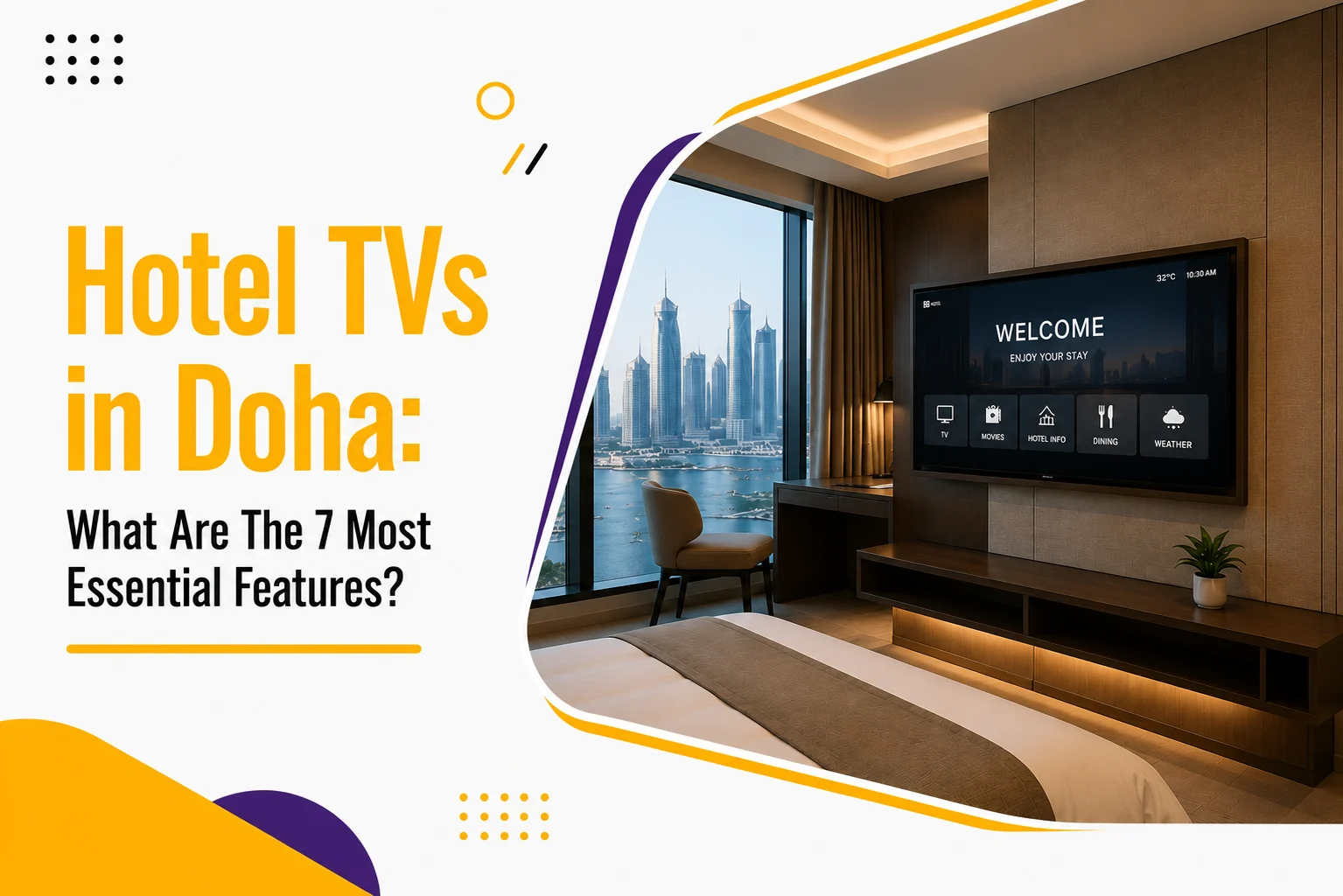
The in-room entertainment experience directly shapes how guests rate their stay. According to a 2025 Hospitality Technology report, 74 percent of hotel guests say in-room technology significantly influences their likelihood to return. In the highly competitive hospitality market of Doha, that number is significant.
Doha hotels are upgrading faster than ever. Properties across the city are investing heavily in guest suite renovations, and the TV is often the centerpiece of that investment. Getting it right the first time saves money, reduces complaints, and keeps guests coming back.
This blog breaks down the 7 most essential features to look for when purchasing Hotel TVs for your Doha property in 2026.
Why the Right Hotel TVs Change Everything
Not all televisions are built for the demands of hospitality. A standard consumer TV placed in a hotel room will fail within months because it is not designed for continuous use, centralized management, or the kind of guest traffic a busy Doha property sees year-round.
Choosing the right hotel TVs protects your investment and your reputation. The features below are non-negotiable for any serious hospitality buyer in Doha.
Feature 1 – LYNK Content Protection
Security starts at the screen. Hotel TVs equipped with Pro:Idiom or LYNK DRM technology ensure guests can only access approved content and nothing more.
Without these measures, guests can accidentally or intentionally access installer menus, reset settings, or disrupt the system for the next guest. That creates real operational headaches at scale.
Key benefits of content protection include the following:
- It locks guests out of backend settings entirely.
- It protects premium content licensing agreements.
- It maintains consistent channel lineups across all rooms.
- It prevents unauthorized configuration changes.
This feature is a baseline requirement for any property sourcing from a bulk TV supplier in Doha, so never skip it during procurement.
Feature 2 – IPTV and Streaming Compatibility
Guests in 2026 expect Netflix, YouTube, and screen casting as standard. If your hotel TVs cannot support these, guests will notice and mention it in their reviews.
IPTV compatibility allows properties to run branded welcome screens, local channel packages, and on-demand content all through one unified system. It also enables dynamic content updates without physically touching the TV.
What to confirm before purchasing includes:
- Native IPTV input support
- Chromecast or Miracast casting capability
- App store or sideloading flexibility for streaming platforms
- Compatibility with your existing network infrastructure
Feature 3 – Commercial-Grade Panel and Durability
This aspect is where hotel TVs separate from consumer sets entirely. The commercial displays in Qatar properties rely on are built for 16 to 24 hours of daily use. Consumer TVs are rated for roughly 4 to 6 hours.
A commercial-grade panel delivers several advantages:
- Superior heat management for extended runtime
- Higher brightness levels suited to varied lighting conditions
- Longer warranty periods, often 3 to 5 years
- Stronger physical construction for high-traffic environments
Skimping here is a false economy. A cheaper consumer set replaced every 18 months will cost far more than a properly rated commercial unit purchased once and maintained correctly.
Feature 4 – Energy Efficiency and Low Power Consumption
Running dozens or hundreds of hotel TVs around the clock adds up fast. Energy efficiency is not just a sustainability talking point because it represents a direct line to reduced operating costs every single month.
Look for these energy-saving features:
- ENERGY STAR certification or regional equivalent
- Auto power-off when no signal is detected
- Ambient light sensors that adjust brightness automatically
- Power scheduling through centralized management systems
Doha properties with large room counts can see meaningful savings on electricity bills annually just by choosing displays with better energy ratings. For any B2B television sales in Doha, the procurement team should have energy efficiency as a standard checklist item rather than an afterthought.
Feature 5 – Screen Size and Resolution Options
Room size dictates screen size. There is no universal answer because a 43-inch display works well in a compact business room, while a suite might call for 65 inches or larger.
Choosing the right resolution for Hotel TVs matters equally:
- FHD at 1080p is sufficient for standard rooms up to 50 inches.
- 4K UHD is recommended for suites, premium rooms, and anything above 55 inches.
- HDR support enhances picture quality noticeably in higher-end room categories.
The hospitality screens in Qatar, buyers often underestimate how much resolution impacts perceived quality. In high-end Doha properties especially, 4K is quickly becoming the baseline expectation rather than the premium option. Size and resolution decisions should be made room category by room category, not as a blanket property-wide call.
Feature 6 – Centralized Management and Remote Control
Managing a single TV is simple. Managing 200 is a different challenge entirely. Hotel TVs with centralized management systems allow your team to handle everything from one dashboard.
Capabilities to look for include:
- Push firmware updates to all units simultaneously
- Edit channel lists and welcome messages without entering rooms
- Schedule power on and off cycles across the full property
- Monitor unit status and flag faults remotely in real time
- Generate usage reports to support maintenance planning
This feature alone can significantly reduce maintenance labor costs across a full year of operations. For digital signage screens in Qatar deployments that extend beyond guest rooms into lobbies and corridors, centralized control becomes even more operationally critical.
Feature 7 – Digital Signage and Multi-Use Capability
Modern hotel TVs are not limited to guest rooms. The same commercial TVs can serve as wayfinding displays in corridors, promotional screens in lobbies, and menu boards in food and beverage outlets, which are all managed through one platform.
This dual-purpose functionality delivers measurable value:
- It reduces the need for separate signage hardware budgets.
- It keeps branding consistent across every touchpoint in the property.
- It allows real-time content updates for events, promotions, and announcements.
- It simplifies vendor relationships and IT infrastructure management.
Properties investing in commercial TVs that support multi-use deployment are getting significantly more return from each unit purchased. It is one of the smartest ways to stretch a hospitality technology budget in 2026.
What to Look for When Buying in Bulk
Buying a single TV and buying 150 are entirely different procurement exercises. Bulk purchasing introduces supplier reliability, lead times, and after-sales support as critical decision factors alongside unit price.
Vetting Your Supplier
Not every vendor is equipped to handle large-scale hospitality orders. Before committing to a purchase, dig into their track record with comparable projects.
Warranty and After-Sales Support
Confirm what happens when a unit fails six months into deployment. A credible supplier will offer on-site replacement or swap programs, dedicated account support for B2B clients, and transparent warranty terms with no buried exclusions.
Stock Availability and Lead Times
Doha project timelines do not flex easily. Your supplier needs to hold sufficient inventory or have confirmed supply chains that can reliably meet your move-in or renovation completion date.
Total Cost of Ownership
The unit price is only part of the equation. Smart procurement teams look at the full cost across a 3 – 5 year operational window.
Installation and Setup Costs
Factor in mounting, cabling, IPTV configuration, and initial setup per room. These costs scale quickly across a full property and should be confirmed with your supplier before signing any agreement.
Ongoing Maintenance Expenses
Ask about firmware support lifecycles, spare parts availability, and whether remote management tools are included in the purchase price or licensed separately on an annual basis.
How Adonai Solutions Supports the Hospitality Sector of Doha
Adonai Solutions has established itself as a trusted supplier of commercial-grade furnishings and technology for hospitality projects across Qatar. Their portfolio covers everything from guest room furniture to bulk electronics procurement, making them a practical single-source partner for hotel fit-out projects of all sizes.
Their profound understanding of the local market means they consistently work within Qatar’s procurement timelines and project realities without friction.
For properties sourcing Commercial TVs Brackets in Doha at scale, Adonai Solutions offers reliable stock availability, structured bulk pricing, and dedicated after-sales coordination.
Whether you are outfitting a boutique property or a large-scale hotel tower in Doha, their team is built to support B2B buyers who need consistency, accountability, and speed from the first inquiry through final installation.
Conclusion
The right hotel TVs do more than entertain guests because they protect your investment, reduce operational friction, and contribute directly to guest satisfaction scores. In the growing hospitality market of Doha, these technology decisions carry long-term financial consequences that compound over every operating year.
Prioritize content protection, IPTV compatibility, commercial-grade durability, energy efficiency, correct sizing and resolution, centralized management, and multi-use capability. Prioritize content protection and select high-quality commercial TVs to ensure long-term value. Get those features right, and your screens will deliver genuine value well beyond check-in day.
If you are planning a bulk purchase for your Doha property, work with suppliers who understand the Qatar market and can back their products with real, responsive after-sales support.
Upgrade Guest Experience with Premium Hotel TVs
Enhance every guest stay with smart, high-quality Hotel TVs designed for seamless entertainment, easy management, and modern hospitality.
Frequently Asked Questions
What makes commercial-grade panels better suited for hotel environments than standard consumer sets?
Commercial-grade panels are engineered for continuous operation, often running 16 to 24 hours daily without performance degradation. They feature advanced heat dissipation systems, higher brightness tolerance, and longer-rated component lifespans compared to consumer alternatives. Consumer TVs are designed for home use at roughly 4 to 6 hours per day, which means they degrade quickly under hotel conditions, leading to frequent replacements and rising long-term costs. The build quality difference is significant enough to affect guest experience within the first operating year. For any hospitality buyer, investing in commercial TVs from the start is the financially sound decision across a 5-year property cycle. Prioritizing durability at the procurement stage eliminates a significant source of operational disruption down the line. Working with an experienced local provider like Adonai Solutions ensures your property secures the most durable hardware.
How many units typically qualify as a bulk order when sourcing hotel TVs for a Doha property?
Most vendors define bulk orders starting from 20 to 50 units, though thresholds vary widely by supplier. Larger properties purchasing 100 or more units typically unlock better per-unit pricing, priority delivery scheduling, and dedicated account management throughout the project. It is worth clarifying minimum order thresholds with your supplier early in the procurement process to avoid misaligned expectations. Some vendors also offer phased delivery for properties completing room renovations in stages rather than all at once, which helps manage storage constraints on active construction or renovation sites. Always confirm minimum order quantities, delivery phasing options, and payment milestone structures before finalizing your vendor selection for any large-scale hospitality project.
What screen sizes are most commonly recommended for standard hotel rooms in Qatar?
Screen sizing depends on room dimensions and typical viewing distance. For standard rooms, 43 to 55 inch displays are the most widely used range across Doha properties. Suites and premium rooms typically move to 65 inches or larger, with some luxury properties installing 75 inch panels in living areas. A common industry recommendation is to calculate screen size based on a 1.5 to 2 times multiplier of the viewing distance measured in feet. Resolution selection should align with screen size, as 4K becomes noticeably beneficial above 55 inches and is increasingly expected in premium hospitality environments. Always measure the room and confirm mounting wall dimensions before finalizing screen size specifications across a bulk order.
Can the same commercial TV units be used for digital signage in hotel lobbies and corridors?
Yes, and this dual-use capability is one of the strongest value arguments for investing in quality hospitality screens in Qatar buyers should prioritize. Commercial-grade units with signage mode support can display wayfinding content, event schedules, promotional messaging, and branded visuals in public areas. The same centralized management system used for guest rooms can control lobby and corridor displays simultaneously from one interface. This eliminates the need for a separate signage hardware budget and simplifies IT infrastructure significantly. Properties using a unified display ecosystem report faster content updates, fewer vendor relationships to manage, and reduced total maintenance overhead across the property. It is a smart consolidation that pays back quickly.
What certifications should procurement teams verify before placing a large order with a bulk TV supplier that vendors in Doha recommend?
Certifications to verify include ENERGY STAR or equivalent regional energy ratings, CE or FCC compliance markings, and commercial-use classifications from the original manufacturer. Content protection certifications like Pro:Idiom licensing are also essential for properties planning to offer premium or encrypted channel packages. Fire safety ratings matter for installations in enclosed or high-occupancy spaces. Always request a formal product specification sheet and confirm that the certifications apply to the exact model being quoted, not just the brand’s general product line. Counterfeit or grey-market units may carry copied certification labels without genuine compliance behind them. Verifying certifications protects both your guests and your property’s liability position. Procurement teams frequently coordinate with Adonai Solutions to ensure all international equipment certificates meet local regulatory frameworks.
How does centralized management reduce operational costs for large hotel properties?
Centralized management systems allow hotel engineering and IT teams to control all screens across a property from a single dashboard without entering individual rooms. Firmware updates, channel list changes, welcome message edits, and power scheduling can all be executed remotely, eliminating labor hours previously spent on physical room visits for routine maintenance. For a 200-room property, such a system can save hundreds of labor hours annually. Fault detection features flag units that are offline or underperforming, enabling proactive maintenance before guests experience disruption. Over a 3 to 5 year deployment period, centralized management delivers measurable reductions in both labor costs and guest complaint rates linked to in-room technology failures.
Are B2B television sales in Doha suppliers able to provide installation support alongside bulk unit supplies?
Many established suppliers offering commercial displays in Qatar properties rely on providing installation support as part of their B2B service packages, though the extent of this varies significantly by vendor. Some offer full turnkey solutions covering delivery, wall mounting, cabling, IPTV system configuration, and staff training in a single engagement. Others supply units only and work alongside your nominated installation contractor. It is important to clarify the scope of supplier support before signing any agreement, as installation costs and timelines can vary considerably depending on room count, building infrastructure, and system complexity. Requesting a detailed service scope document upfront prevents gaps in accountability during the installation phase and protects your project timeline.